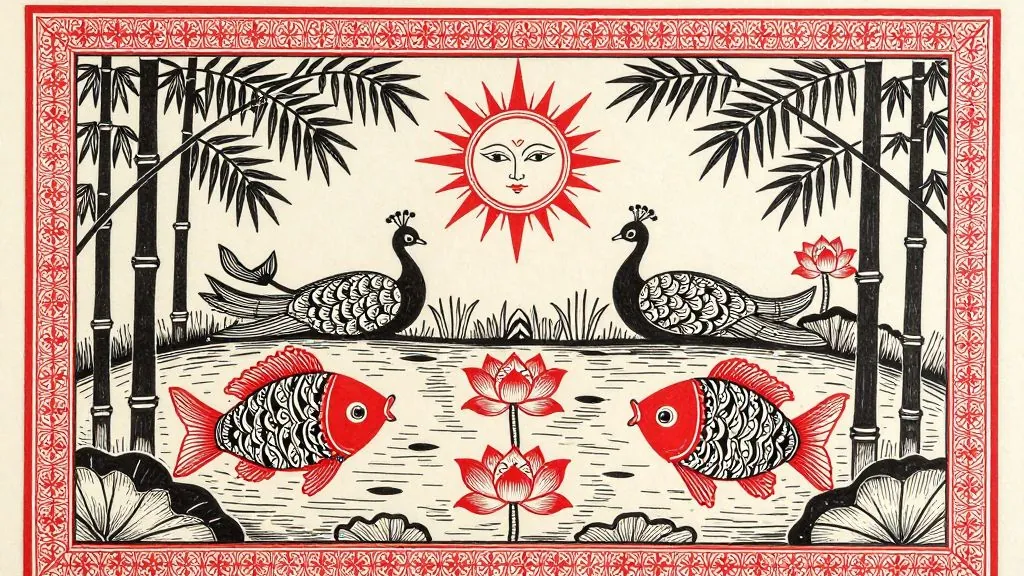
Madhubani leaves no space empty. Every gap is filled with fish, flowers, birds and pattern, as if the painting itself were alive.
What is Madhubani painting?
Madhubani painting is a folk painting tradition from the Mithila region of Bihar in India and neighbouring parts of Nepal, known for bold double outlines, bright natural colours and surfaces filled edge to edge with pattern. It originated in the Madhubani district, which gives it its best-known name; it is also known by the name of the wider region, Mithila art.
For most of its history it was not “art” in the gallery sense at all. It was something the women of a household did: a form of ritual painting for particular occasions, such as a birth, a marriage or a festival. The pictures were made to bless a home and an event, and they were meant to be renewed, not preserved.
Local tradition gives it an ancient origin. In the legend, when Sita was to marry Rama, her father King Janaka of Mithila asked for paintings to capture the moments of the wedding. Whether or not the story is history, it tells you what the art was for: marriage, family and good fortune.
How was Madhubani traditionally made?
Traditionally, women painted on freshly plastered mud walls and floors, using colours and brushes they made themselves. Every material came from the household and the land around it:
- Colours: ochre, lampblack, vermilion, turmeric, indigo, and flowers of the palash tree.
- Brushes: slivers of bamboo, twigs, sticks and scraps of cloth, which painters still use today.
- Surfaces: first the walls and floors of the home, and from the 1960s onwards handmade paper, cloth and canvas.
What is a kohbar painting?
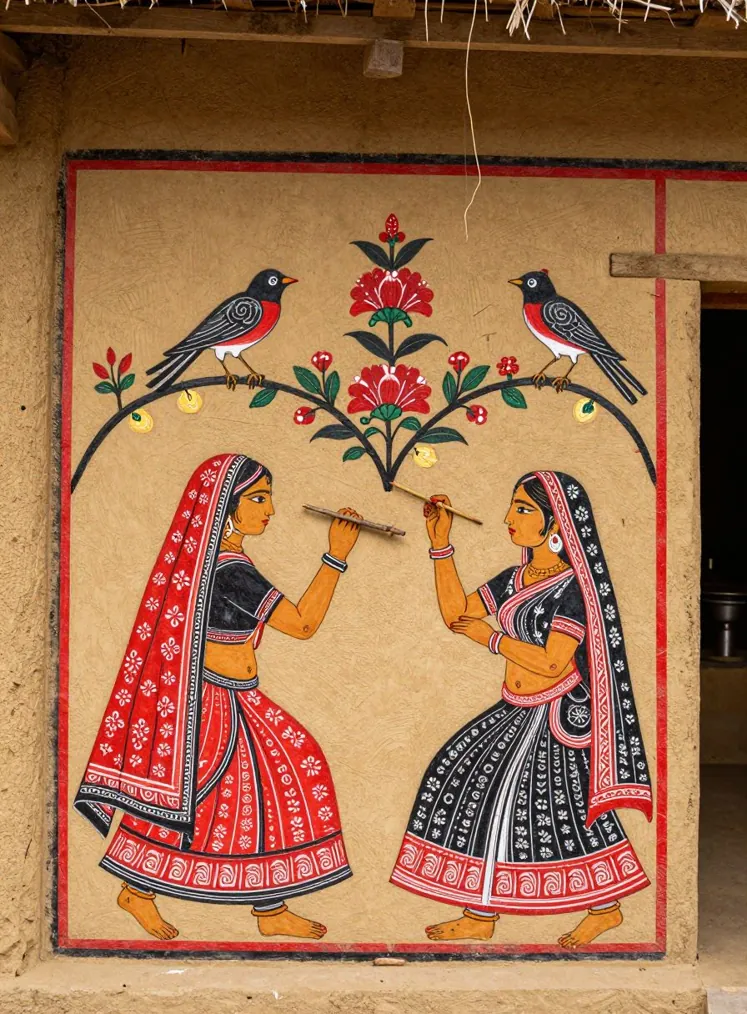
A kohbar is the painting on the wall of the wedding chamber, the room where a newly married bride and groom spend their first night together. It is also called puren. It was the most important painting a family made, and the one most full of meaning.
Its symbols speak of love, fertility and a life together. When William Archer saw the walls of Mithila homes in 1934, he found lotus ponds, flowers, snakes, fish, turtles, parrots and peacocks, alongside gods such as Shiva and Parvati. Kohbar paintings often build a circular motif at their centre, drawn in red and black. Different communities painted their kohbar differently; there are, for example, distinct Brahmin and Kayastha versions.
We write about the wider tradition of love in Indian art, from temple doorways to wedding walls, in Love in Indian Art.
How did an earthquake bring Mithila art to the world?
On 15 January 1934 a deadly earthquake struck northern Bihar and Nepal. William G. Archer, a British civil servant posted in Madhubani, went through the damaged villages and noticed that behind the fallen walls, the inner rooms of houses were covered in elaborate paintings. They had been made by the women of those households, mostly in the kohbar-ghar, the marriage chamber, as part of wedding rituals.
Archer documented what he saw and in 1949 published an essay on the paintings in Marg, the Indian art magazine. It was the first serious written account of the art, and it laid the foundation for everything that followed. But for another two decades the paintings stayed where they had always been: on walls, made for families, not for sale.
How did Madhubani move from walls to paper?
It moved in the 1960s, out of both curiosity and hardship. Pupul Jayakar, who led the All India Handicrafts Board, wanted the paintings documented, and enlisted the Bombay artist Bhaskar Kulkarni to find them. In the villages of Jitwarpur and Ranti he found women willing to recreate their wall paintings on paper.
Hardship made that experiment a livelihood. According to the heritage organisation Sarmaya, it was during Bihar’s famine of 1966–67 that Mithila art found a commercial purpose on paper. Painting on paper and canvas brought new income to women in an impoverished region, and the pictures could now travel.
Travel they did. Foreign admirers followed: the German anthropologist Erika Moser collected paintings from 1973 and helped build a women’s centre; the American anthropologist Raymond Owens bought work at fairer prices, founded the Ethnic Arts Foundation and set up the Mithila Art Institute. In Japan, Tokio Hasegawa founded a Mithila Museum in Tokamachi, established around 1982.
Who are the great women artists of Madhubani?
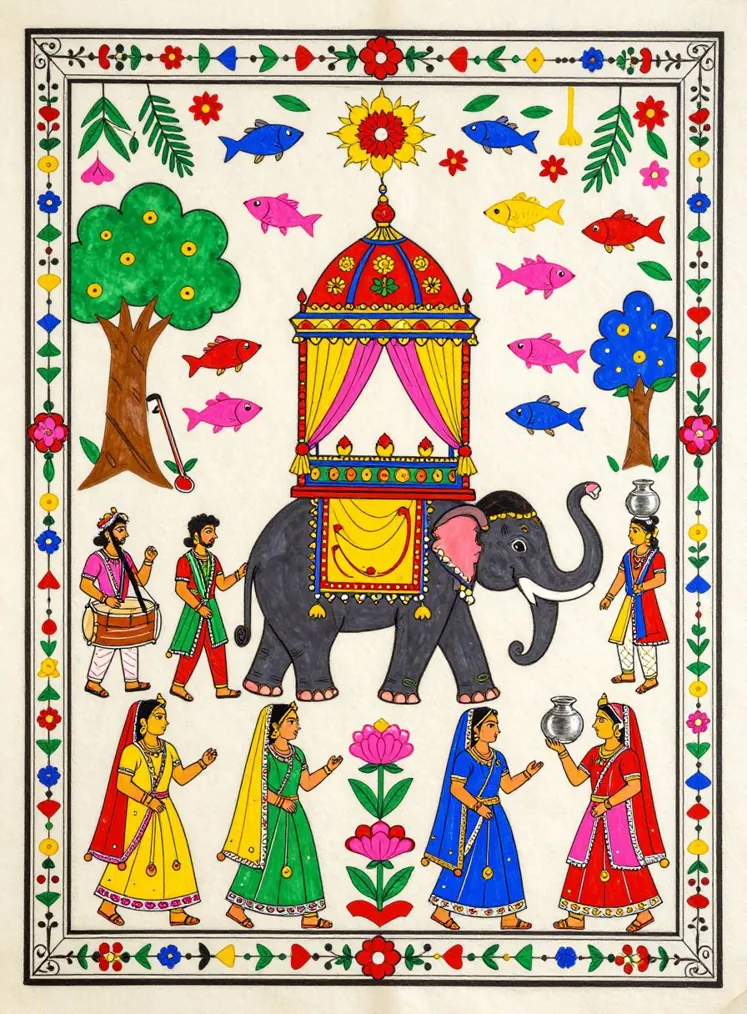
Madhubani’s history is a history of named women, and it is worth learning their names. Many of the first painters to work on paper became masters honoured by the Indian state:
- Jagdamba Devi, a Brahmin painter, received the Padma Shri in 1975.
- Sita Devi, also from a Brahmin family, received a state award in 1969, the Padma Shri in 1981, the Bihar Ratna in 1984 and the Shilp Guru award in 2006.
- Ganga Devi, a Kayastha painter, received the Padma Shri in 1984. In the 1970s she and Sita Devi represented India in Japan, Europe, the USSR and the United States.
- Mahasundari Devi, a Kayastha painter, received the Padma Shri in 2011.
- Baua Devi of Jitwarpur began painting on paper as a teenager in the 1960s, received a National Award in 1984 and the Padma Shri in 2017, and was the only Mithila artist in the landmark 1989 exhibition Magiciens de la Terre.
- Dulari Devi received the Padma Shri in 2020.
Beyond the Brahmin and Kayastha households
The earliest paper paintings came mostly from Brahmin and Kayastha women, but painters from other communities soon made the art their own, bringing in their own lives and symbols. Women of the Dusadh community, among them Lalitha Devi, Chano Devi and Shanti Devi, developed the Godna style from the patterns of protective tattoos, and Jamuna Devi of the Chamar community became a respected painter too. Men such as Santosh Kumar Das and Gopal Saha now paint as well.
Painters travelled, and their subjects travelled with them. Sita Devi painted Arlington National Cemetery and the World Trade Center; Ganga Devi drew her hotel in Moscow. Today’s artists also take on global warming, female foeticide and bride burning, alongside the old stories of gods and weddings.
What are the five styles of Madhubani painting?
Painters and scholars usually describe five styles. They differ in technique and in origin, though today many artists move freely between them:
- Bharni, from the Maithili word for “filling”: bold double outlines filled with solid, bright colour. In the 1960s it was mostly practised by Brahmin women, often for religious subjects.
- Kachni, the line style: pictures built from fine parallel lines and hatching with no solid fill, often in black alone or black and red, and historically associated with Kayastha women.
- Tantrik: sacred diagrams and deities from tantric worship, also painted mostly by Brahmin women in the 1960s.
- Godna, from the word for tattoo: fine patterns, birds and trees of life, largely in black ink, traditionally on a base smeared with cow dung. Sarmaya credits Dusadh women with developing it; the Dastkari Haat Samiti describes it as the work of the Paswan community.
- Kohbar: the wedding-chamber painting, dense and colourful, with parrots, fish, elephants, the sun, bamboo and the lotus as symbols of fertility and blessing.
What they share
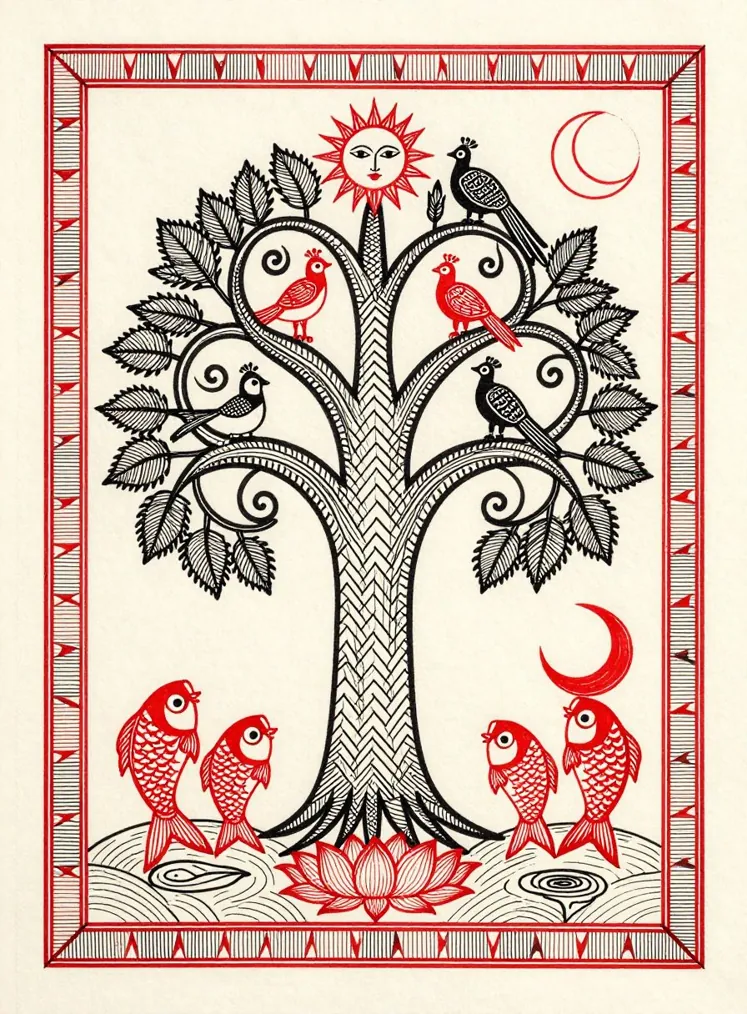
Whatever the style, Madhubani paintings share a family likeness: double outlines, eye-catching geometric patterns, flat colour rather than shading, and a refusal to leave any space empty. Where a Kangra miniature opens into a deep green landscape, a Madhubani painting presses everything up to the surface, like a textile. Compare it with the hill painters in The Painters of Kangra.
Is Madhubani painting protected, and is it still alive?
Yes to both. Madhubani Paintings from Bihar are registered as a Geographical Indication; India’s GI list records the registration in 2006–07. A Geographical Indication ties a product’s name to the place and community that make it, much as Champagne is tied to a region of France.
The art is also very much alive in public life. In 2012, local painters in Bihar were employed to paint trees, using a mix of lime, glue and synthetic enamel, as a way to discourage people from cutting them down. Madhubani now decorates government school walls, office boundary walls, railway stations and the walls of Patna, far from any wedding chamber.
How does KamZour approach Madhubani?
With respect for the women who made it. Our style library keeps Kohbar Painting and Mithila Lokchitra as separate styles, because the wedding wall has its own vocabulary of lotus, bamboo and fish, while the wider tradition covers everything from Kachni line work to Bharni colour. When you choose one in Imagine, the style supplies the double outlines and the filled spaces; you supply the story.
We think the best way to use a style like this is to learn where it comes from first. An AI picture in the Mithila manner is not a Mithila painting, and it never replaces one. If a Madhubani picture moves you, look up the artists named above, and buy from painters and cooperatives in Bihar. Our philosophy explains why we care about keeping living traditions visible.
Frequently asked questions
What is the difference between Madhubani and Mithila painting?
They are two names for the same tradition. Mithila is the name of the wider cultural region of Bihar and Nepal where the art is made; Madhubani is the district at its centre, whose name became the art’s best-known label.
Who discovered Madhubani painting?
Nobody discovered it; the women of Mithila had painted it for generations. The outside world noticed it after the Bihar earthquake of 15 January 1934, when the British official William G. Archer saw paintings inside damaged houses, and he published an essay on them in Marg in 1949.
What does a kohbar painting mean?
A kohbar is the painting on the wall of the wedding chamber, where the bride and groom spend their first night. Its symbols, such as the lotus, bamboo, fish, parrots and peacocks, express love, fertility and blessings for a shared life.
What are the five styles of Madhubani art?
Bharni, filled with bright colour; Kachni, built from fine lines and hatching; Tantrik, with sacred diagrams and deities; Godna, based on tattoo patterns; and Kohbar, the wedding-chamber style.
Does Madhubani painting have a GI tag?
Yes. Madhubani Paintings from Bihar are registered as a Geographical Indication in India, with registration recorded in 2006–07, which protects the name for work made in the region.
Who are famous Madhubani artists?
Among the best known are Jagdamba Devi, Sita Devi, Ganga Devi, Mahasundari Devi, Baua Devi and Dulari Devi, all of whom received the Padma Shri, one of India’s national civilian honours.
References and further reading
- Wikipedia: Madhubani art
- Sarmaya: The Walls Have Eyes, the discovery and evolution of Mithila art
- Sarmaya: Behind Painted Walls, the story of Baua Devi and Mithila painting
- The Better India: How a British officer spotted Mithila art during an earthquake
- Wikipedia: List of Geographical Indications in India
- Google Arts & Culture: Bihar’s Madhubani Art Decorates Its Environment