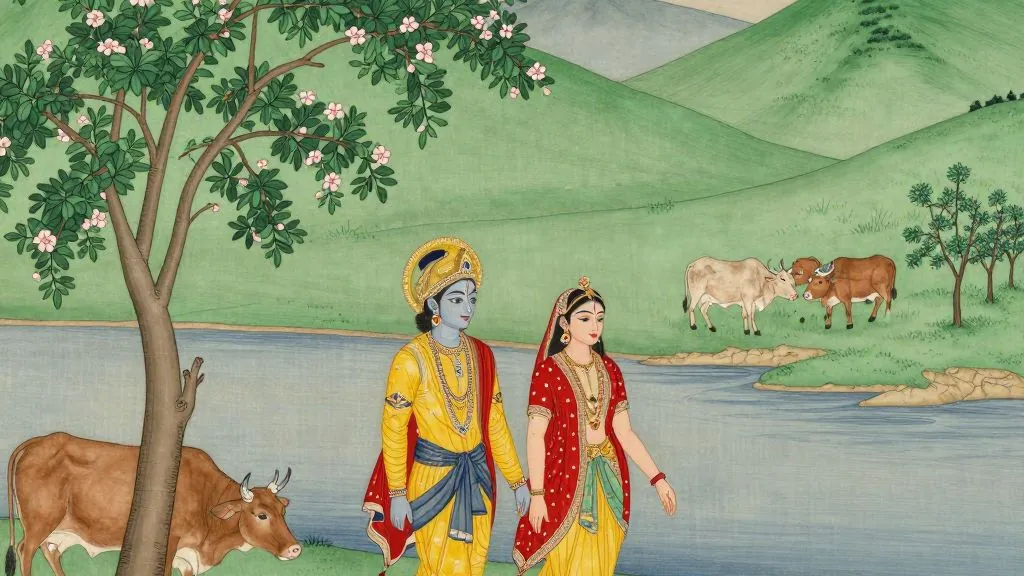
Kangra painters did not paint the gods as distant idols. They painted them as lovers walking by a river in the evening light.
What is Kangra painting?
Kangra painting is a school of Indian miniature painting from the hill kingdoms of present-day Himachal Pradesh, famous for its gentle, naturalistic pictures of Radha and Krishna. It began at the court of Guler in the first half of the eighteenth century and became, under Maharaja Sansar Chand of Kangra, the leading style of the western Himalaya.
It belongs to a larger family called Pahari painting. Pahari simply means “of the hills”, and the term covers the miniature painting of the lower Himalayan kingdoms from the seventeenth to the mid-nineteenth century. Its centres included Basohli, Guler, Kangra, Chamba, Mandi, Nurpur, Jammu and Garhwal. Each small court had its own taste, but painters moved between them, and families of artists served several rulers over a lifetime.
Scholars agree that Pahari painting grew out of Mughal painting, even though its patrons were Rajput hill rajas. Kangra is where that inheritance became something new: a style that keeps Mughal refinement but turns it towards devotion, landscape and feeling.
How did Kangra painting differ from the earlier Basohli style?
The short answer: Basohli is bold and blazing, Kangra is cool and lyrical. The Basohli school, credited with starting Pahari painting in the mid-seventeenth century, used flat fields of intense colour, strong outlines, large eyes and architecture set against a square, stage-like background.
Kangra painters kept the love stories but changed almost everything else about how they were told. Their drawing is fine and fluid. Their colours come from mineral and vegetable sources and have what writers often call an enamel-like lustre. Their landscapes use many shades of green, and their faces are modelled so softly that they are often compared to porcelain. Where Basohli shouts, Kangra speaks quietly.
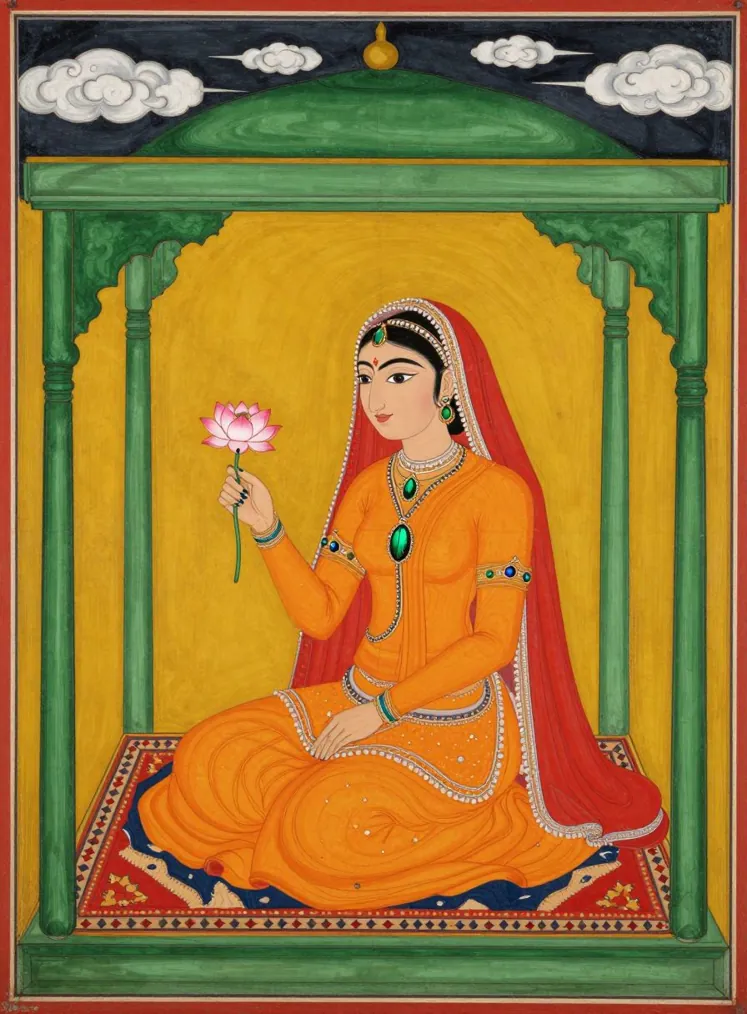
Who were the painters of Kangra?
At the heart of the story is a single family from Guler. The painter Pandit Seu and his family settled in Guler, a small hill state, and set up a workshop there. Their genealogy survives unusually well, because the family recorded its members in the pilgrimage registers (bahis) kept by priests at Haridwar.
The court they served mattered too. In the first half of the eighteenth century, Raja Dalip Singh of Guler (r. 1695–1741) gave shelter to painters from Kashmir who had trained in the Mughal manner. That meeting of Mughal technique and hill devotion is where the Guler style, and later the Kangra style, began. A later ruler of Guler, Raja Govardhan Chand, went on to commission sets of the Bhagavata Purana and the Gita Govinda.
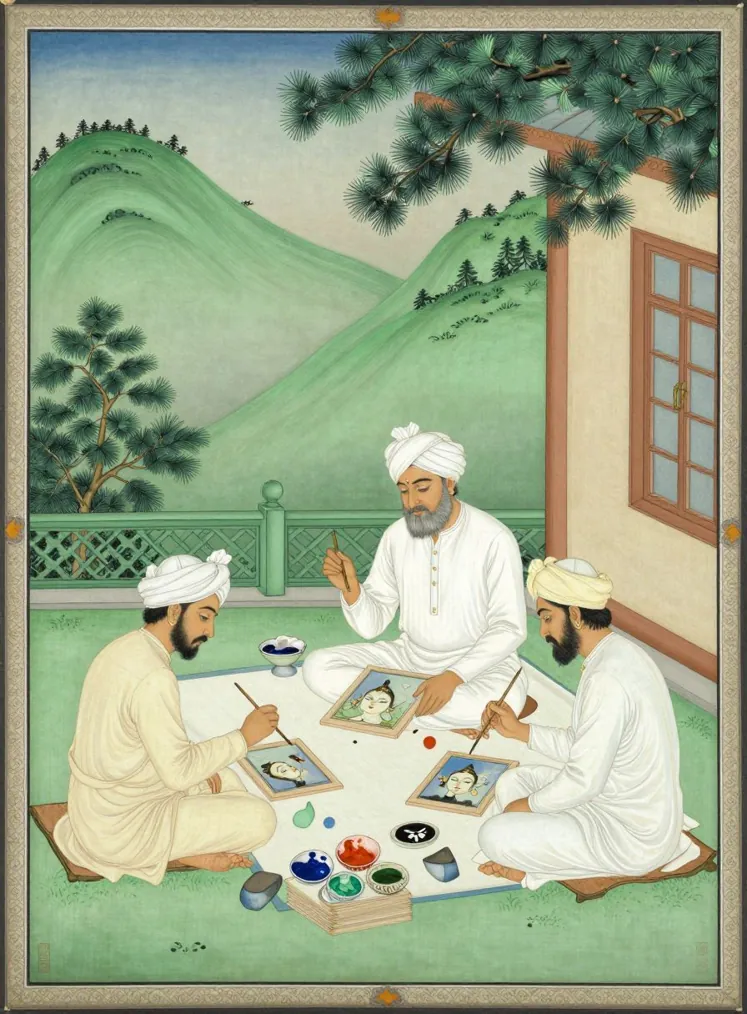
Manaku of Guler (c. 1700–1760)
Manaku, the elder son, was about ten years older than his brother. A leaf showing the poet Jayadeva worshipping Radha and Krishna, from a Gita Govinda of about 1730, is in the National Museum, New Delhi. Like his brother, Manaku almost never signed his work; only four surviving paintings carry his signature. His name was largely forgotten until the art historian B. N. Goswamy led the research that recovered it.
Nainsukh (c. 1710–1778)
Nainsukh trained in the family workshop and then left Guler. From about 1740 to 1763 he worked for Raja Balwant Singh (1724–1763) of the small court of Jasrota, painting his patron’s daily life with an observant naturalism rare in Indian painting. After Balwant Singh’s death he served Raja Amrit Pal of Basohli, turned increasingly to religious subjects, and died at Basohli in 1778.
Goswamy noted some of his habits: grounds left uncoloured, shading laid in with a light wash, and a fine horizontal line separating the ground from the background. In 2010 the filmmaker Amit Dutta made a feature film about his life.
The first generation after Manaku and Nainsukh
The workshop did not end with the brothers. Museums group their sons together as the “first generation after Manaku and Nainsukh”:
- Fattu (c. 1725–1785) and Khushala, the sons of Manaku.
- Kama (c. 1735–1810), Gaudhu (c. 1740–1820), Nikka (c. 1745–1833) and Ranjha (c. 1750–1830), the sons of Nainsukh.
Why did Kangra painting flourish under Sansar Chand?
Because a gifted workshop met a ruler who loved its subject. Maharaja Sansar Chand Katoch of Kangra ruled from the 1770s until his death in 1824 (sources give slightly different dates for his reign). He was an ardent devotee of Krishna, and under him Kangra became the most important centre of Pahari painting.
His court atelier was probably led by Purkhu (active about 1780–1820), who recorded both the public and private life of his patron and painted religious series from the Harivamsa, the Shiva Purana, the Ramayana and the Gita Govinda. Purkhu’s pictures are more matter-of-fact than the dreamlike work of the Guler masters: a court chronicle rather than a reverie.
The golden age did not last. In 1806 the Gurkhas, allied with hill states Sansar Chand had defeated, invaded Kangra, and in 1809 the great fort of Kangra passed to Maharaja Ranjit Singh. Sansar Chand spent his last years on the estates left to him, devoted to cultural pursuits, and died at Nadaun in 1824. Painting continued in the hills into the nineteenth century, but patronage thinned, and cheaper chemical paints gradually replaced the old hand-ground pigments.
What stories do Kangra paintings tell?
Mostly stories of love, human and divine. The central theme of Pahari painting is the love of Radha and Krishna, and Kangra painters returned to it again and again. Their main sources were:
- *The Gita Govinda***: Jayadeva’s twelfth-century song-poem of Radha and Krishna’s longing, quarrel and reunion.
- *The Bhagavata Purana***: the great narrative of Krishna’s childhood and youth among the cowherds of Vrindavan.
- Nala and Damayanti: the story of King Nala and Princess Damayanti. A Kangra leaf of their married happiness, attributed to Nainsukh’s son Ranjha and dated about 1800–10, is in the Metropolitan Museum of Art in New York.
- *The baramasa***: cycles of seasonal poems for the twelve months of the year.
- Heroes and heroines in love (nayaka and nayika), the types of lover described by classical poetry. We tell their stories in The Eight Heroines.
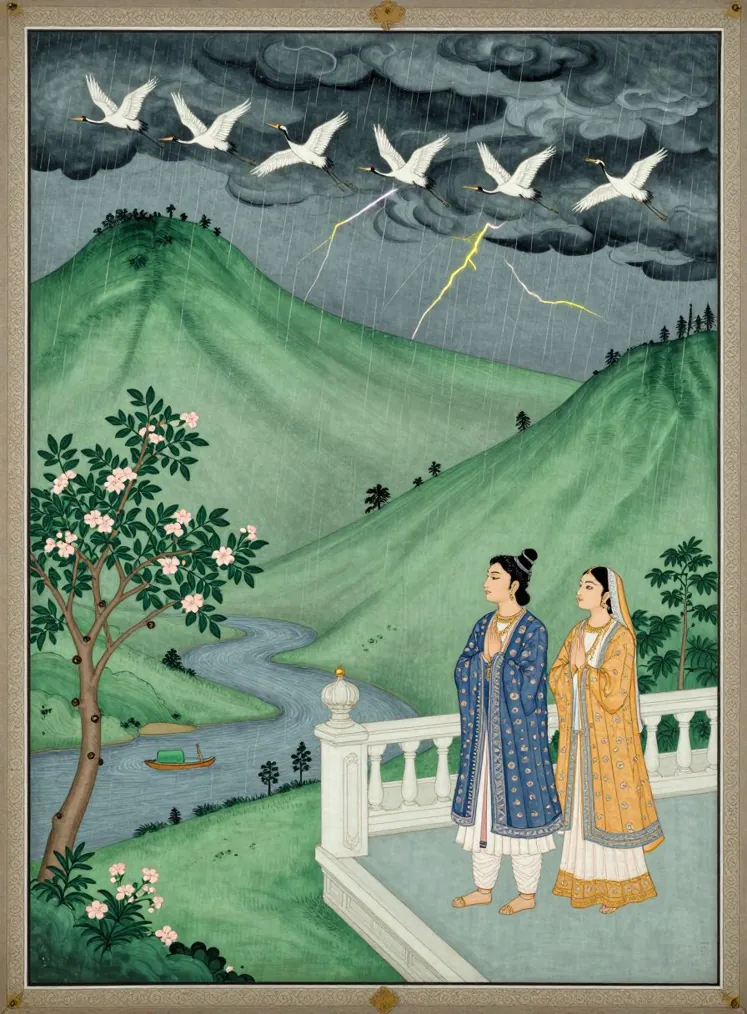
How was a Kangra miniature made?
Slowly, by hand, and in layers. The Wereldmuseum in the Netherlands, which holds 134 drawings and paintings from the Punjab Hills, describes a process that took a picture from a sheet of paper to a burnished jewel:
- The drawing. The painter sketched a rough outline with a charred twig, drew a second outline in red or yellow ink, and fixed the final contours in black.
- The primer. A coat of white primer was laid over the whole composition to soften the black lines, and colour was then built up in increasingly concentrated layers.
- The pigments. Minerals such as vermilion and orpiment, and organic colours such as indigo and lac, were crushed, washed, ground to powder, mixed with gum and stored in freshwater mussel shells.
- The brushes. Painters made their own from goat, camel or cat hair; the finest, for faces, came from the hair of a squirrel’s tail.
- Gold and polish. For rich patrons, gold leaf was rubbed into a dish with a little water and honey and applied as paint, and the painter burnished the surface with a polishing stone to close the pores of the paper and even out the colour.
Why the pictures glow
That burnishing is part of the secret of Kangra’s famous lustre. Mineral colour, laid on in thin layers over a white ground and polished smooth, reflects light the way enamel does. It is also why the originals look so different from most reproductions: the surface is meant to be seen close up, tilted slightly in the hand, as it would have been in an album.
Where can you see Kangra paintings today?
In India, the National Museum in New Delhi and the Bharat Kala Bhavan in Varanasi hold important Pahari paintings, including works by Manaku. Abroad, Kangra paintings are in collections such as the Metropolitan Museum of Art in New York, the Philadelphia Museum of Art, the Museum of Fine Arts in Boston and the Museum Rietberg in Zurich, and many can be explored online.
The tradition is also still alive, if fragile. In 1973 the Himachal Pradesh government set up a training centre at the village of Rait under the painter Chandu Lal Raina, who taught 35 artists until 1993. Today groups such as the Kangra Arts Promotion Society in Dharamshala run workshops, and Kangra painting is registered as a Geographical Indication, which protects its name. Painters still face high costs and competition from digital prints.
How does KamZour paint in the Kangra manner?
In the KamZour Studio, Imagine, Kangra is not one generic “Indian miniature” filter. Our style library keeps Kangra Painting, Guler Painting, Basohli Painting and Pahari Miniature as separate styles, because the differences above matter: a Basohli picture asks for flat, blazing colour; a Kangra picture asks for cool greens, soft modelling and a quiet mood.
When we write a style, we describe exactly those qualities: the fine line, the mineral palette, the burnished surface, the verdant hills. How a Style Is Built walks through how we turned a Pahari miniature into a style anyone can use. And when someone asks for Radha and Krishna, Imagine paints them the way the hill painters did: fully dressed, tender and dignified, as our Community Standards ask for sacred figures. Our pictures never show the real painters of Guler or Kangra; they imagine the kind of workshop they worked in.
Frequently asked questions
What is Kangra painting famous for?
Kangra painting is famous for tender, naturalistic pictures of Radha and Krishna set in green Himalayan landscapes. Its hallmarks are fine, fluid drawing, cool mineral colours with an enamel-like lustre and delicately modelled faces.
Who founded the Kangra school of painting?
No single person founded it, but one family shaped it: Pandit Seu of Guler, his sons Manaku and Nainsukh, and their six sons, known as the first generation after Manaku and Nainsukh. The style reached its height at the court of Maharaja Sansar Chand of Kangra.
What is the difference between Pahari and Kangra painting?
Pahari painting is the umbrella term for miniature painting from all the hill kingdoms of the western Himalaya, including Basohli, Guler, Chamba, Mandi and Kangra. Kangra painting is one school within it, the most lyrical and naturalistic.
What materials were used in Kangra paintings?
Painters worked on paper with pigments ground from minerals such as vermilion and orpiment and from organic sources such as indigo and lac, mixed with gum. They made their own brushes, using squirrel-tail hair for the finest detail, and burnished the finished surface with a polishing stone.
Is Kangra painting still practised today?
Yes, though on a small scale. A government training centre opened at Rait in 1973, groups in Dharamshala run workshops, and the style is protected as a Geographical Indication, but painters face high costs and competition from digital prints.