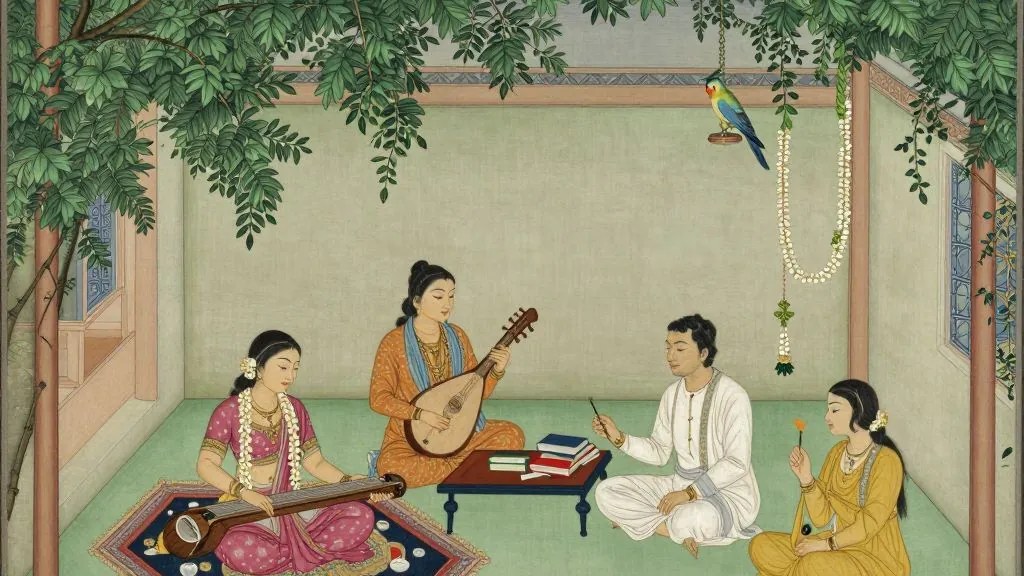
A good life, in this old Indian view, is a well-made one: made with the hands, the voice and the imagination.
What are the sixty-four arts?
The sixty-four arts are a classical Indian list of the skills that made a person cultured. In Sanskrit they are the chatushashti kalas: kala means an art or a skill, and chatushashti means sixty-four. The most famous list opens with singing, playing instruments and dancing, then runs on through painting, perfume-making, cooking, carpentry, architecture, gardening, word games and the training of talking birds.
The list is not a catalogue of fine art in the modern, gallery sense. It is closer to a portrait of a whole life lived with skill and taste. A beautifully laid bed of flowers, a clever riddle, a well-built room and a painted panel all belong to the same family of achievement. That breadth is what makes the list so interesting today, and why we call it India’s first curriculum of creativity.
Who wrote the list of sixty-four arts, and when?
The best-known list was set down by Vatsyayana Mallanaga, a scholar who probably lived in the second or third century CE, most likely in Pataliputra, today’s Patna in Bihar. Historians give a wide range for his book, but the scholar Wendy Doniger dates the surviving version to the second half of the third century CE. At its close, Vatsyayana says he composed it while living as a religious student in Benares.
His handbook is the Kamasutra. The name makes many people think only of love-making, but the book is much wider than that. It has about 1,250 verses in 36 chapters, organised into seven books, and it opens with the general principles of a good life. The sixty-four arts appear in Book 1, Chapter 3, right before a chapter describing the house and daily routine of the nagaraka, the cultivated townsman.
The text was first translated into English in 1883, in an edition associated with Richard Burton. The English names we quote below come from that translation, which is now in the public domain. The number sixty-four appears more than once in the book; the list discussed here is the list of general arts, the one Vatsyayana says should be studied alongside his treatise.
What is on the list of sixty-four arts?
The list begins with the arts we still recognise as arts, then widens into almost every corner of a well-run, well-enjoyed life. Grouped loosely (the text itself simply numbers them), they fall into a few families.
Music, performance and the spoken word
The first four entries are singing, playing on musical instruments, dancing, and the union of all three. Stage playing, mimicry, and reading aloud with chanting and intoning follow later. So does one of the most delightful items on the list: playing on musical glasses filled with water.
Picture making and adornment
Writing and drawing sit fifth on the list, and picture making, trimming and decorating is fourteenth. Around them cluster the arts of adornment:
- Tattooing, and colouring the teeth, garments, hair and nails.
- Arraying and adorning an image of a deity with rice and flowers.
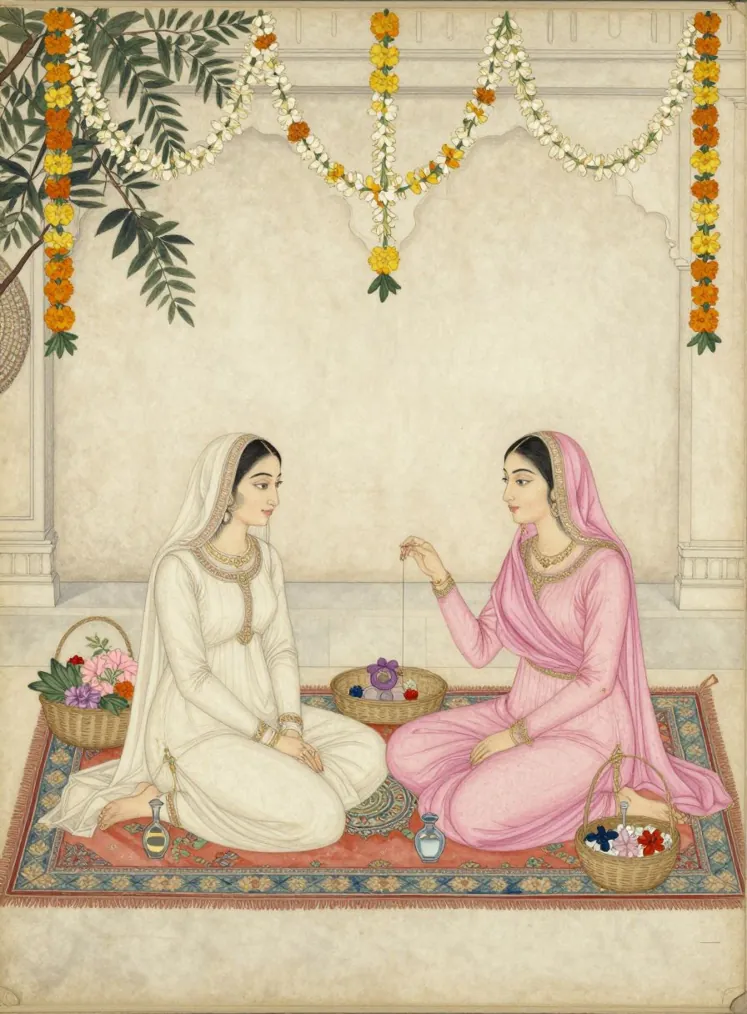
- Stringing rosaries, necklaces, garlands and wreaths, and binding turbans and chaplets.
- Making ear ornaments, and the proper arrangement of jewels and dress.
The home, the table and the garden
Here the list becomes a manual of gracious living: preparing perfumes, cooking, and making lemonades, sherbets and other drinks with proper flavour and colour; tailoring and sewing; spreading carpets and cushions; storing water in cisterns and reservoirs; and gardening, including knowing how to treat the diseases of trees and plants.
Building and making
Carpentry and architecture are on the list, as are chemistry and mineralogy, knowledge of coins and gems, colouring jewels and beads, knowledge of mines and quarries, making artificial flowers, and making figures and images in clay.
Games of the mind
A cultured person was expected to be quick-witted company. The list includes solving riddles and verbal puzzles; a verse game in which each player must begin a new verse with the last letter of the previous one; completing a stanza from a fragment; composing poems; reasoning; writing in cipher; knowledge of dictionaries, of metre, and of languages and vernacular dialects; and arithmetical recreations.
Surprises
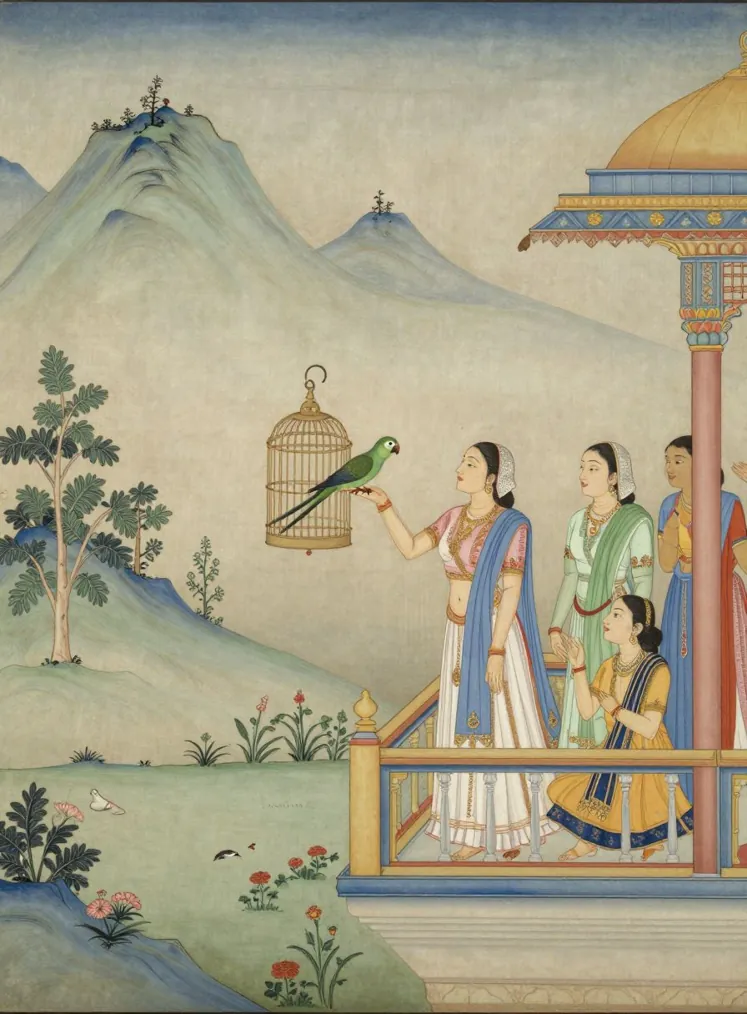
Then there are the entries no modern syllabus would include: making parrots and flowers out of yarn, making flower carriages, the art of disguise, and the art of teaching parrots and starlings to speak. The list is also honest about its world. It includes practice with sword, staff and bow, gambling, magic and charms, and cock, quail and ram fighting. Not every item has aged well, but together they show how wide the idea of a cultured life once was.
Who was expected to learn the sixty-four arts?
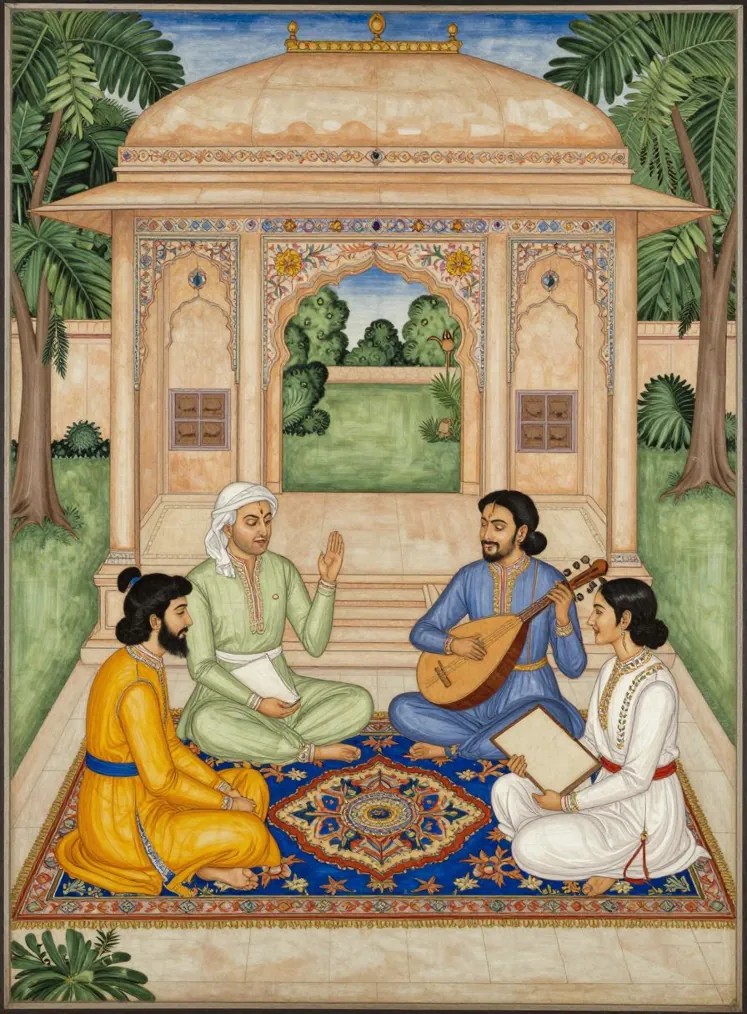
Everyone who hoped to live well: men, women and professional artists alike. Vatsyayana writes for the cultivated townsman, but he is unusually clear that women should study the arts too, learning in confidence from a nurse’s married daughter, a trusted friend or her mother’s sister.
His reasons are practical as well as romantic. In the 1883 translation, he says that a woman who knows the arts gains independence: “Even if a wife becomes separated from her husband, and falls into distress, she can support herself easily, even in a foreign country.” The arts, in other words, were a livelihood as well as a grace.
The most accomplished women of the arts held real standing. The text says that a public woman of good disposition and beauty, “also versed in the above arts, obtains the name of a Ganika, or public woman of high quality.” The ganika was a courtesan of the highest rank, esteemed by kings and learned people alike, and often better educated and more skilled in music, dance and the other arts than most married women of her time.
What did a day in the cultivated life look like?
It looked like the list put into practice. The chapter after the sixty-four arts describes the nagaraka’s house and day, and the furnishings are the tools of the arts. His room holds, in the 1883 translation, “a lute hanging from a peg made of the tooth of an elephant, a board for drawing, a pot containing perfume, some books, and some garlands of the yellow amaranth flowers.”
Outside there is a garden with “a whirling swing and a common swing, as also a bower of creepers covered with flowers.” The day moves from bathing and grooming to meals, conversation, games and evening music with friends. The birds get their lessons too: “After breakfast, parrots and other birds should be taught to speak.”
Read today, the striking thing is how ordinary creativity was meant to be. The lute is on the wall, the drawing board is at hand, and the garlands are fresh. Making things was not a profession set apart from life. It was the texture of a cultivated day.
Is Vatsyayana’s the only list of sixty-four arts?
No. Vatsyayana’s is the most quoted, but lists of sixty-four arts appear across Indian tradition. Traditional scholarship names other enumerations, including those in the Shukraniti, attributed to Shukracharya, in Shaiva texts, and in commentaries on the Bhagavata Purana. The number became a byword for complete cultivation.
The number also took on sacred meaning. Shiva is regarded as the master of the arts, and the goddess Saraswati, patron of learning, music and speech, is called Chausath Kalamayi, she who possesses the sixty-four arts. The Lalita Sahasranama, a hymn of a thousand names of the Goddess, invokes her as the embodiment of the sixty-four arts.
Traditional learning also drew a useful distinction. A vidya was a discipline of knowledge, organised for study and teaching, such as grammar or logic. A kala was an applied art, a craft with a direct bearing on everyday life. A rounded education needed both.
Which of the sixty-four arts are still practised today?
More than you might expect. Many of the arts on the list are simply what people in India still do, at home, in markets and on stage:
- Music, dance and theatre, which grew into the classical performing traditions.
- Garlands and flowers, strung daily for homes, temples and weddings.
- Designs of rice and flowers, echoed today in the rangoli, kolam and pookkalam made on floors and thresholds from rice flour, coloured powders and petals.
- Cooking and drinks, with every region’s sweets and sherbets.
- Word play and verse games, alive in riddles, poetry contests and the love of a clever turn of phrase.
What do the sixty-four arts mean for KamZour?
They are where our name and our philosophy begin. KamZour was built around the idea at the heart of Vatsyayana’s list: paying attention, making things beautifully and delighting in skill are part of living well, and anyone can practise them. Our illustrated essay, Our philosophy, sets out the whole list of sixty-four as a window of coloured glass, one tile for each art.
The Studio, Imagine, is our small modern addition to picture making, trimming and decorating. It invites you to bring your own idea and choose from more than a thousand styles, from Pahari miniature to Madhubani, the way a cultivated person once reached for the drawing board on the wall. To see how one of those styles is described, read How a Style Is Built. And to understand what the arts were meant to make you feel, read What Is Rasa? and our history of love in Indian art.
Frequently asked questions
What are the 64 arts in Indian tradition?
The 64 arts, or chatushashti kalas, are a classical list of skills that made a person cultured. The best-known version, in Vatsyayana’s handbook, includes music, dance, painting, perfume-making, cooking, carpentry, architecture, gardening, riddles, languages and teaching parrots to speak.
Where do the 64 arts come from?
The most quoted list is in Book 1, Chapter 3 of the Kamasutra, compiled by Vatsyayana, probably in the second or third century CE. Other Indian texts, such as the Shukraniti and some Shaiva works, give their own lists of sixty-four.
Were the 64 arts only for men?
No. Vatsyayana says women should learn the arts too, and argues that a woman who knows them could support herself even if she were left alone in a foreign country. The most accomplished women of the arts, the ganikas, were held in high esteem at court.
Which goddess is associated with the 64 arts?
Saraswati, the goddess of learning, music and speech, is called Chausath Kalamayi, the possessor of the sixty-four arts. The Lalita Sahasranama also invokes the Goddess as the embodiment of the sixty-four arts, and Shiva is regarded as the master of the arts.
Is the Kamasutra only about sex?
No. It is a broad handbook on a cultivated life. Its opening book covers the aims of life, the sixty-four arts, and the house and daily routine of a person of taste, and only some of its seven books deal with intimacy.