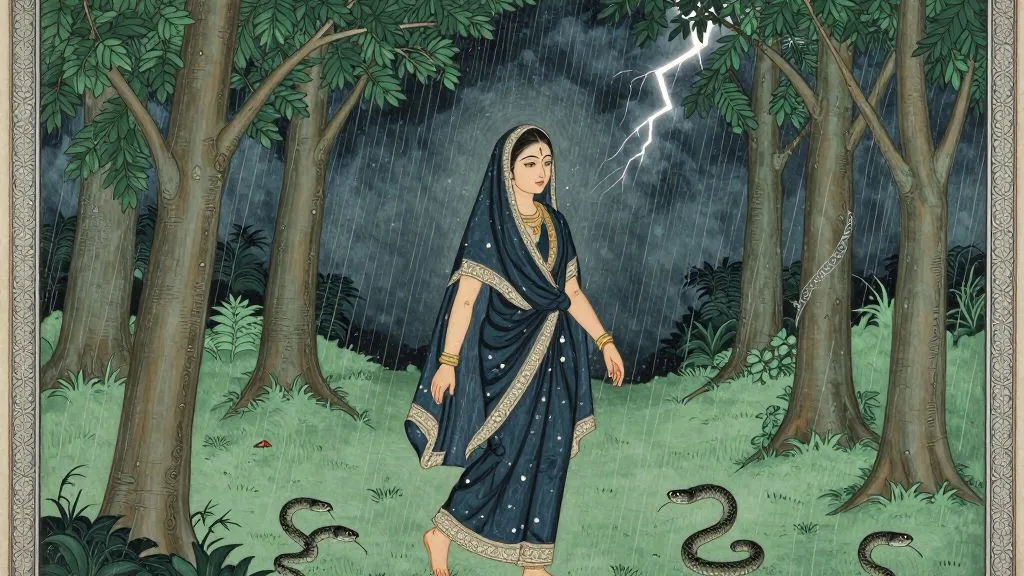
Each nayika is less a person than a moment of the heart, painted so that anyone who has loved will recognise it.
What are the Ashta Nayika?
The Ashta Nayika (“eight heroines”) are eight classic types of heroine in Indian literature, theatre, painting and dance. Each is defined not by who she is but by what she is going through: her state, or avastha, in relation to her beloved, the hero or nayaka.
The classification first appears in the Natya Shastra, the great Sanskrit treatise on the performing arts attributed to the sage Bharata. Scholars date its first complete version to between about 200 BCE and 200 CE; in its most studied form it runs to about 6,000 verses in 36 chapters, covering everything from stagecraft to gesture. The list of heroines sits in its twenty-fourth chapter, as a guide for actors who had to show, not tell, what a character felt.
That origin explains the scheme’s genius. The nayikas are not portraits of real women. They are situations of the heart, sharp enough for an audience to recognise at a glance, and general enough that anyone who has waited for someone, or quarrelled and regretted it, can see themselves in them.
Why did Indian aesthetics classify heroines by emotion?
Because classical Indian aesthetics treats feeling as something that can be studied, refined and shared. The Natya Shastra describes the rasas, the emotional flavours a work of art awakens in its audience, and the first of them is Shringara, the rasa of love. Our essay What Is Rasa? explains the theory in depth.
Shringara has two halves: sambhoga, love in union, and vipralambha, love in separation. The eight heroines are divided between them. Three belong to union: the heroine who prepares for her beloved, the heroine whose beloved is devoted to her, and the heroine who goes out to meet him. The other five all belong to separation.
That balance says something about Indian poetry and painting. Five of the eight moods are about absence: a closed door, an empty path, a broken promise, a letter from far away. The tradition found longing more expressive than possession, and painters found it endlessly paintable.
Who are the eight heroines?
Here they are in the order the Natya Shastra gives them, with the meaning of each Sanskrit name and the way painters usually showed her. Later poets sometimes used other names for the same heroine, and those are given too.
1. Vasakasajja: the heroine who makes ready
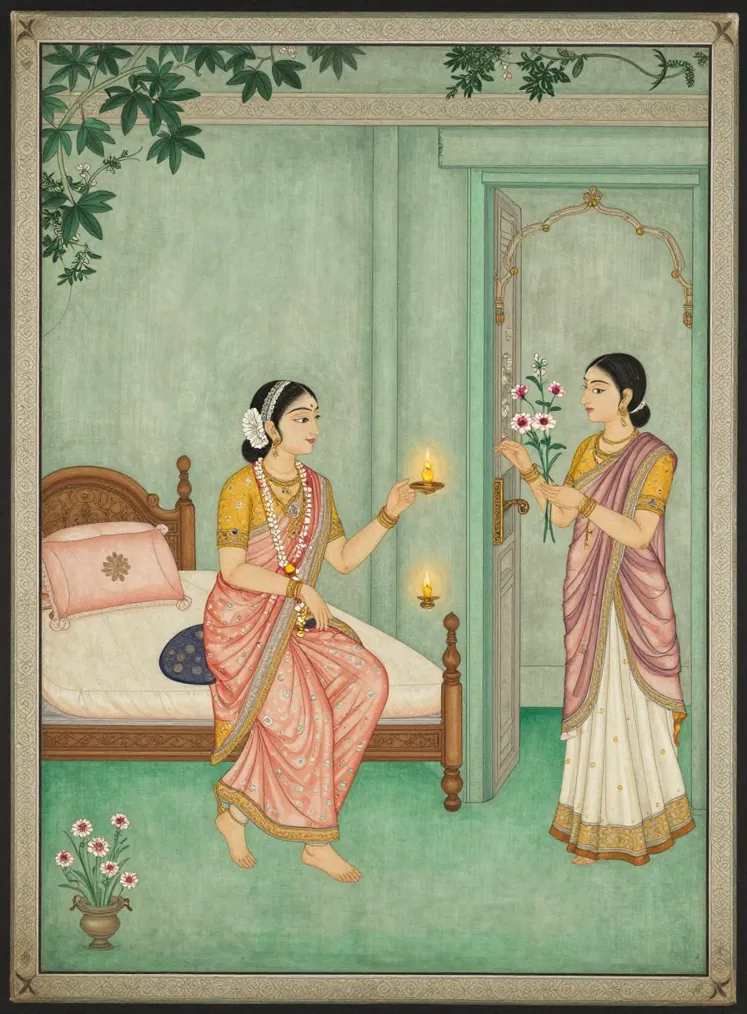
Vasakasajja (“one dressed up for union”) waits for her beloved, who is returning from a long journey. She dresses, arranges garlands and lamps, and prepares the chamber, glancing toward the door. The poet Keshavdas compared her beauty to that of Rati, the goddess of love, waiting for her husband Kamadeva. A sculpture of her is found at the Lakshmana Temple in Khajuraho.
2. Virahotkanthita: the heroine who pines
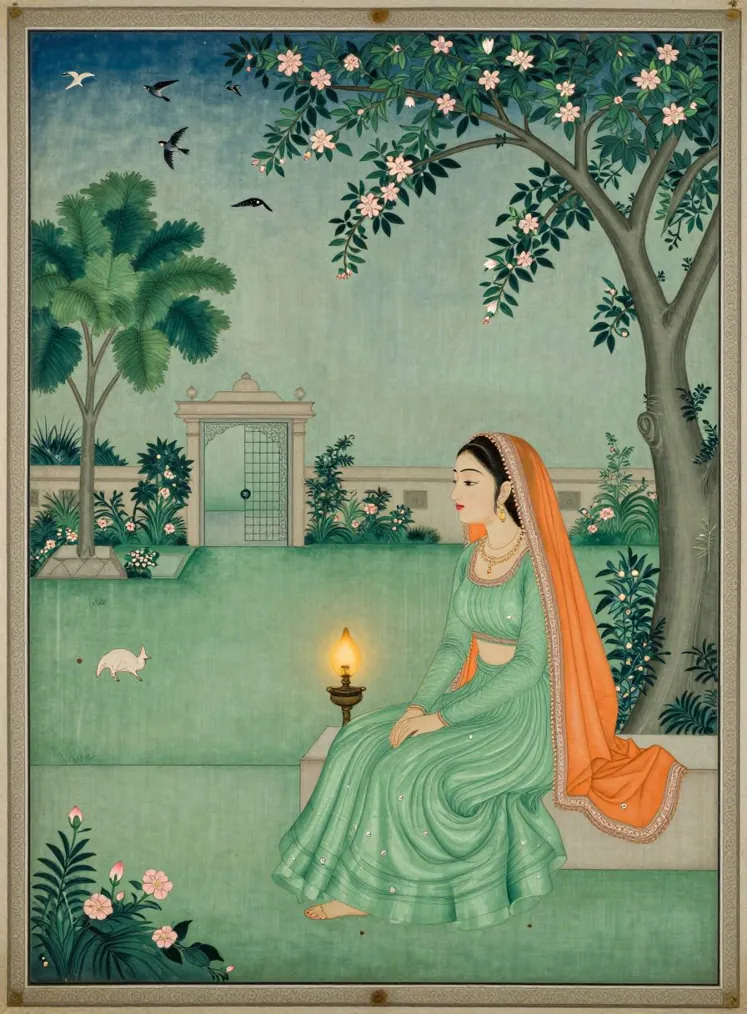
Virahotkanthita (“one distressed by separation”), whom Keshavdas calls Utka, waits for a beloved who is kept away by his duties and does not come. Painters show her sitting or standing out in a pavilion or a garden, watching the path. A folio in the Los Angeles County Museum of Art, painted at Uniara in Rajasthan around 1760, seats her on a saffron carpet in a landscape with peacocks and herons under a stormy sky.
3. Svadhinabhartruka: the heroine who is cherished
Svadhinabhartruka, or Svadhinapatika in Keshavdas, is the heroine whose beloved is completely devoted to her. Painters often show him kneeling to paint red mahawar on her feet, or placing a vermilion mark on her forehead. In Jayadeva’s Gita Govinda, Radha takes this role with Krishna.
4. Kalahantarita: the heroine who quarrelled
Kalahantarita (“one separated by quarrel”) has driven her beloved away in a moment of jealousy or pride, and now regrets it. In paintings he is often leaving her apartment, downcast, while she turns away; in others she refuses a cup he offers her.
5. Khandita: the heroine who was let down
Khandita (“one enraged with her lover”) was promised that her beloved would come in the evening. He arrives only the next morning, having spent the night elsewhere. She is shown rebuking him at the door.
6. Vipralabdha: the heroine who was deceived
Vipralabdha (“one deceived by her lover”) waited the whole night at the place they had agreed, and he never came. Painters show her throwing away her jewellery, a gesture that needs no words. An eighteenth-century painting of her from Chamba is in the Salar Jung Museum in Hyderabad.
7. Proshitabhartrika: the heroine whose beloved is far away
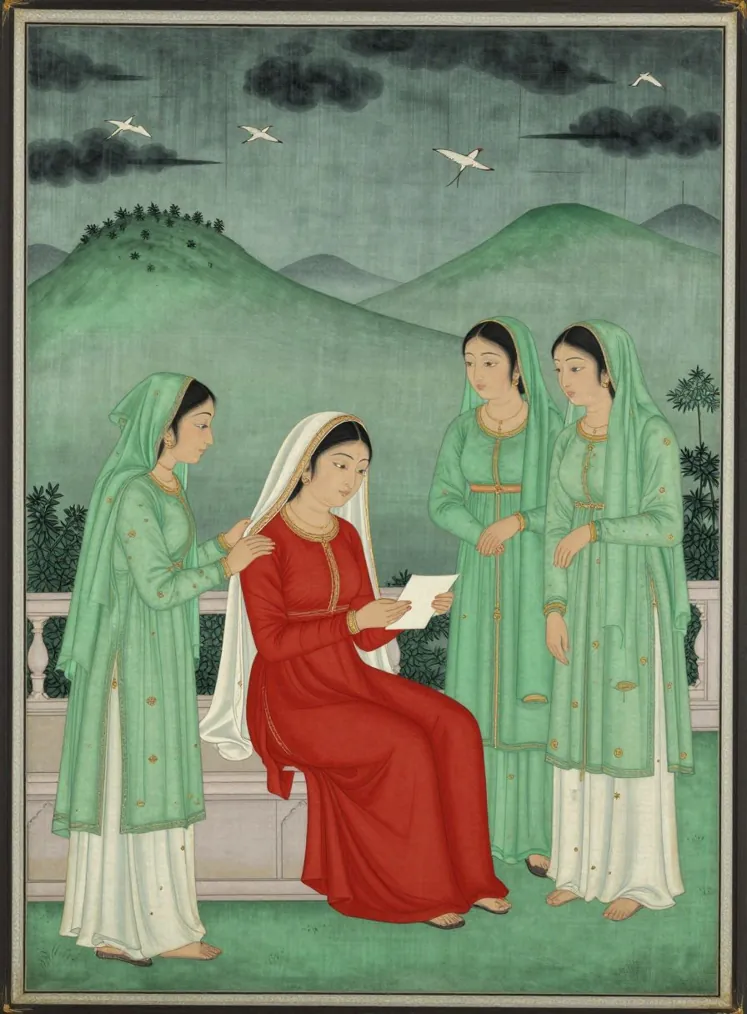
Proshitabhartrika (“one with a sojourning husband”), or Proshitapatika, is the woman whose husband has gone away on business and has not returned on the promised day. She is shown seated and grieving among her companions, refusing to be consoled.
8. Abhisarika: the heroine who sets out
Abhisarika (“one who moves”) leaves her home to go and meet her beloved. She is the painters’ favourite for drama: a figure hurrying through a forest at night, lightning overhead, rain falling and snakes underfoot, unafraid because love leads her. The Garhwal painter Mola Ram (1743–1833) painted her turning back to look at a golden anklet that has just fallen off.
Where do the nayikas appear after the Natya Shastra?
Almost everywhere in Indian poetics. Treatises such as the tenth-century Dasarupaka and the fourteenth-century Sahityadarpana refined the classification, and poets built whole works around it. Three texts matter most for art:
- *The Gita Govinda (12th century).* In Jayadeva’s song-poem, Radha passes through several of the heroines’ states in her love for Krishna, which gave the scheme a devotional meaning: the soul longing for the divine.
- *Bhanudatta’s Rasamanjari (“Bouquet of Rasa”).* Bhanudatta Misra, a Sanskrit poet from Mithila dated to the late fifteenth or early sixteenth century, classified heroines with great subtlety. The scholar Sheldon Pollock wrote that “no other Sanskrit poet exercised anything remotely approaching Bhanudatta’s influence on the development of the Hindi literary tradition between 1600 and 1850.”
- *Keshavdas’s Rasikapriya (“The Connoisseur’s Delight”).* Composed in 1591 in Braj Bhasha, the literary Hindi of the Krishna country, by Keshavdas (1555–1617), court poet at Orchha, it catalogues types of lovers and their emotional states through Radha and Krishna.
How did painters show the eight heroines?
As moods made visible. Rajput and Pahari painters illustrated the Rasikapriya and the Rasamanjari in long series, one heroine per page, often with the verse written above the picture. A Rasamanjari series from Nurpur in the hills, attributed to the painter Kripal and dated about 1660–1670, is one such set; the Bundi school of Rajasthan painted the nayikas among its Ragamala pages; and Kangra painters of the nineteenth century were still painting Utka in a forest full of deer, birds and flowers.
Painters developed a visual shorthand that let a viewer read the mood before reading the verse:
- A lamp and a door for waiting: Vasakasajja and Virahotkanthita.
- Storm, lightning and snakes for the courage of Abhisarika.
- Jewellery flung aside for the disappointment of Vipralabdha.
- A departing figure for the regret of Kalahantarita.
- Clouds, cranes and a letter for the long absence of Proshitabhartrika.
From paper to cloth
The heroines crossed into textiles too. The embroidered Chamba rumal of Himachal Pradesh often shows the Ashta Nayika in eight panels, so that a single cloth holds the whole cycle of love. To see how the hill painters worked, read The Painters of Kangra.
How do dancers perform the eight heroines?
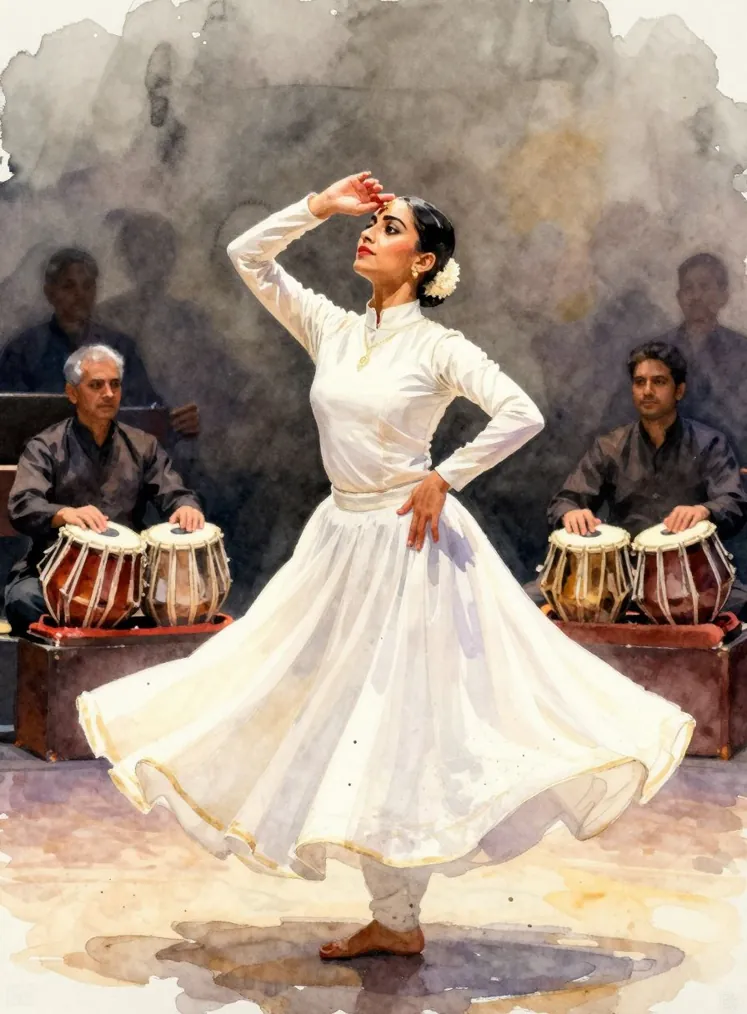
Through abhinaya, the art of expression, which the classical tradition divides into four parts: angika (the body), vachika (the voice), aharya (costume and make-up) and sattvika (inner states). A solo dancer can become each heroine in turn, and then a different one, just by changing her face, the direction of her eyes, her posture and her hand gestures.
The heroines are a familiar theme in Kathak. In Bharatanatyam, the heroine of a varnam is often the pining Virahotkanthita, and many javalis show a heroine who has been let down. In music, the light classical thumri draws on Radha in the many moods of the nayikas.
Music and the heroines were linked on paper too. Bhoja’s Shringara Prakasha related types of heroes and heroines to musical ragas and raginis, and later treatises such as Somanatha’s Ragavibodha (1609) and Damodara’s Sangitadarpana (about 1625) continued the practice, which is one reason nayikas and melodies share pages in painted albums. Read more in Ragamala: When Music Became Painting.
How can you explore the nayikas today?
Start with the paintings. Museums including the Los Angeles County Museum of Art, the Harvard Art Museums, the Salar Jung Museum and the National Museum in New Delhi hold nayika paintings and sculpture, and many can be seen online. Look first for the clue that names the mood (the lamp, the storm, the thrown-away necklace) and then read the verse if there is one.
You can also paint a nayika yourself. In Imagine, choose a style such as Pahari Miniature or Kangra Painting from the Style Library, and describe the moment rather than the person: the empty path at dusk, the letter in her hand, the rain on the road. Imagine paints everyone as a grown adult, fully dressed, and shows the love of Radha and Krishna the way the miniatures do, as our Community Standards describe. The nayikas were always about feeling, and that is what they are best at teaching a painter.
Frequently asked questions
What does Ashta Nayika mean?
Ashta Nayika means “eight heroines” in Sanskrit. It is a classification of eight types of heroine in Indian literature, theatre, painting and dance, each defined by her emotional situation in relation to her beloved.
Which text first describes the eight heroines?
The Natya Shastra, the Sanskrit treatise on the performing arts attributed to Bharata and dated between about 200 BCE and 200 CE. Later works, including the Dasarupaka, the Sahityadarpana, Bhanudatta’s Rasamanjari and Keshavdas’s Rasikapriya, developed the scheme further.
What is an Abhisarika nayika?
The Abhisarika is the heroine who leaves her home to go and meet her beloved. Painters show her crossing a dark forest in a storm, with lightning above and snakes below, to show that love makes her fearless.
What is the difference between Khandita and Vipralabdha?
Both are let down by the beloved. Khandita is angry because he arrives only the next morning after promising to come the night before; Vipralabdha waited all night at the meeting place and he never came at all, so she is shown throwing away her jewellery.
Are the nayikas only about romance?
No. In devotional poetry such as the Gita Govinda, Radha passes through the nayikas’ states in her love for Krishna, and the longing is read as the soul’s longing for the divine. The nayikas are also a teaching tool for actors and dancers learning to express emotion.
How do classical dancers perform the nayikas?
Through abhinaya, the art of expression. A solo dancer in Kathak or Bharatanatyam changes from one heroine to another using facial expression, glances, posture and hand gestures, and audiences who know the tradition recognise each one.
References and further reading
- Wikipedia: Ashta Nayika
- Wikipedia: Natya Shastra
- Wikipedia: Bhanudatta Misra
- LACMA: Anxious Heroine (Utka), folio from a Rasikapriya, Uniara, c. 1760
- Harvard Art Museums: Utka Nayika, page from a Rasikapriya, Kangra
- Wikipedia: Abhinaya
- Kalyani Kala Mandir: Scope for Nayakas and Nayikas in Bharatanatyam
- Wikipedia: Mola Ram