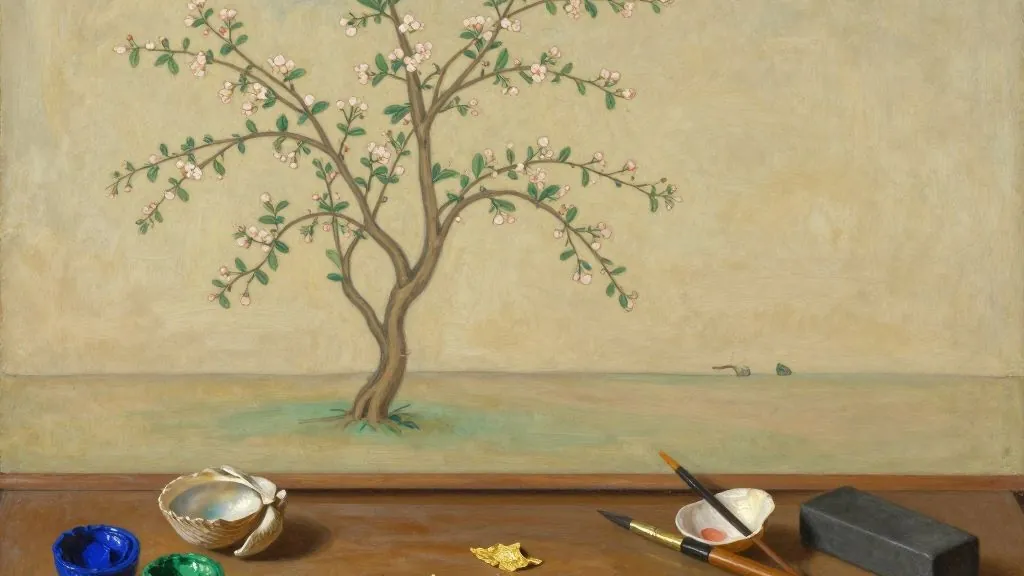
A style is a set of choices repeated with love until they become a language.
What is an art style?
An art style is a set of choices made the same way, again and again, until they become a language. Which colours, and how bright? What kind of line: hard or soft, broken or flowing? How are faces drawn, how is space arranged, what subjects are chosen and what mood is sought? When a school of painters answers these questions consistently for generations, you can recognise their work at a glance, even if you could not say why.
That instant recognition is what this essay unpacks. We take one of the best-loved styles in Indian art, the Kangra school of Pahari painting, and look at the choices that make it itself. Then we show how KamZour writes a tradition like this down, so you can bring your own idea to it in the Studio.
What is Pahari painting?
Pahari means ‘of the hills’. Pahari painting is the miniature painting of the small hill kingdoms of the lower Himalaya, from Jammu to Garhwal through present-day Himachal Pradesh, made from roughly the seventeenth to the mid-nineteenth century. It was not one style but a family of them, named after the courts where they flourished: Basohli, Guler, Kangra, Chamba, Mandi and others.
Basohli is credited with beginning the Pahari school. Over the eighteenth century, the bold early manner gave way to a softer, more naturalistic one that reached its height at Kangra. Many Pahari paintings share round faces and small, deep-set eyes beneath semicircular foreheads, and a devotion to the love of Radha and Krishna, especially as told in Jayadeva’s Gita Govinda.
What makes a Kangra painting look like a Kangra painting?
A handful of choices, made consistently. Kangra painting began at the court of Guler in the first half of the eighteenth century, when painters trained in the Mughal manner found patronage under Raja Dalip Singh (r. 1695–1741). It reached its peak under Maharaja Sansar Chand Katoch of Kangra (r. 1776–1824), a great patron of the art. Across that century, its painters settled on a clear grammar.
Palette
Kangra colours are cool and fresh. They were made from minerals and plants, and the finished surface has an enamel-like lustre. Red, yellow and blue are common, but the overall effect is delicate rather than loud.
Line and figure
The drawing is precise, fluid and lyrical, and faces are shaded with restraint. Women in Kangra painting are drawn with refined features and a porcelain-like delicacy, and the figures are graceful and slender.
Landscape
Nature is almost a character. Kangra paintings are full of verdant greenery: flowering plants and creepers, leafless trees, rivulets and brooks.
Subject and mood
Style is also what painters chose to paint. The most popular subjects were the Bhagavata Purana and the Gita Govinda, and the central feeling was Shringara, the rasa of love, above all in the story of Radha and Krishna. Painters also illustrated the baramasa, the twelve months of the year, each with its own weather and longing. (Our essay What Is Rasa? explains the idea of rasa.)
How did painters build and hand down a style?
In families, by practice. Pahari painting was the work of hereditary workshops, and the most famous is the family of Pandit Seu of Guler. His sons Manaku and Nainsukh (c. 1710–1778) became two of the greatest Pahari painters. Nainsukh worked for nearly twenty years for Raja Balwant Singh of Jasrota, painting his patron’s daily life with rare naturalism: getting his beard trimmed, writing a letter, performing a puja, looking out of a palace window.
Scholars list the ‘devices and mannerisms’ by which Nainsukh’s hand can be recognised, among them a liking for uncoloured grounds, shading with a light wash, a rich green and a particular bush with flat, circular leaves. Those small habits are exactly what a style is made of. Nainsukh’s four sons, and his nephew Fattu, carried the manner forward, and the workshop continued into the nineteenth century; so many works came from it that scholars often attribute them simply to the ‘Family of Nainsukh’.
How a miniature was made
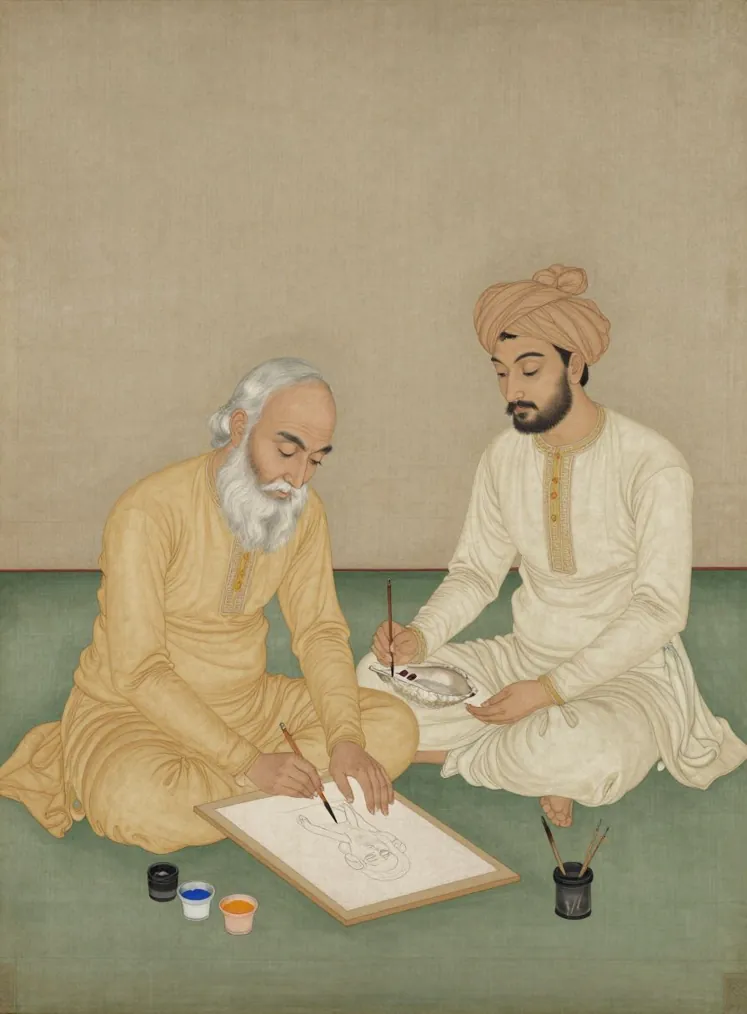
The workshop process was itself part of the style. Painters of the Rajput and Pahari courts worked in opaque watercolour on paper, in careful stages:
- A first sketch in charcoal set out the composition, then the drawing was firmed up with a brush in red sanguine.
- A thin white priming coat went over the paper, and the black lines were strengthened.
- Colour was laid on in layers, and after each coat the painting was burnished face down to fuse the pigments.
- In the step called khulai, ‘opening up’, every outline was made crisp again.
- Last came fine shading, gold, and the minute detailing of pearls and jewellery.
How is Basohli painting different from Kangra?
They are two answers to the same questions. Basohli, the earliest Pahari school, is known for strikingly blazing colours, bold lines and rich symbols; its paintings have been called ‘poems in colours’. Kangra, a century later, chose cool colour, soft air, fluid drawing and deep, green landscape.
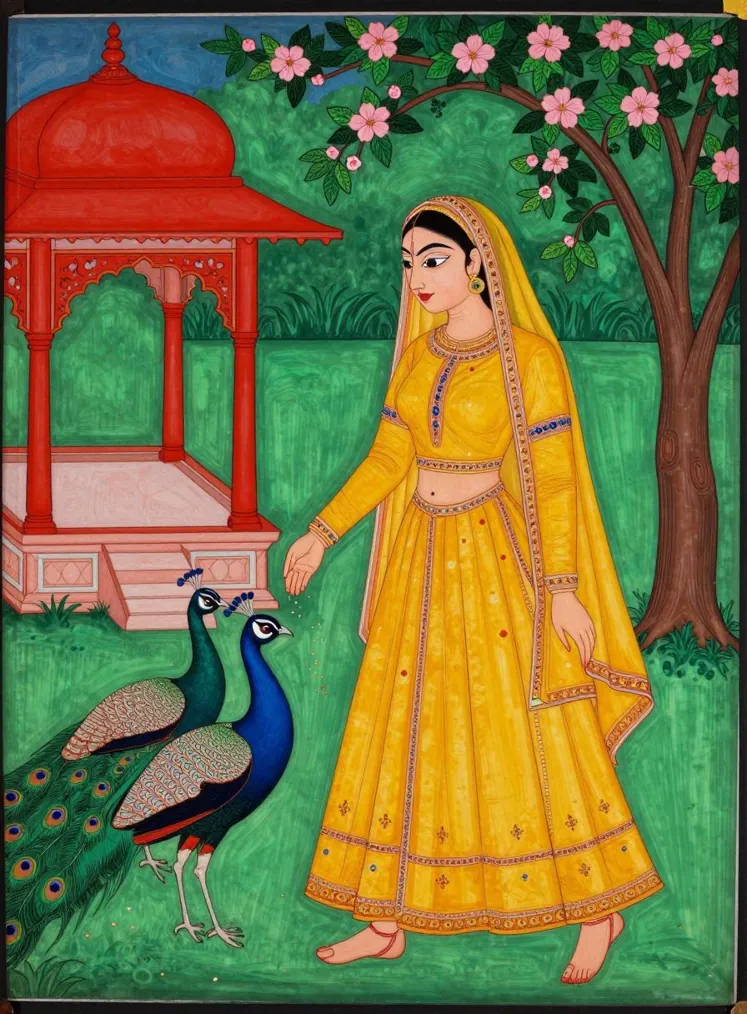
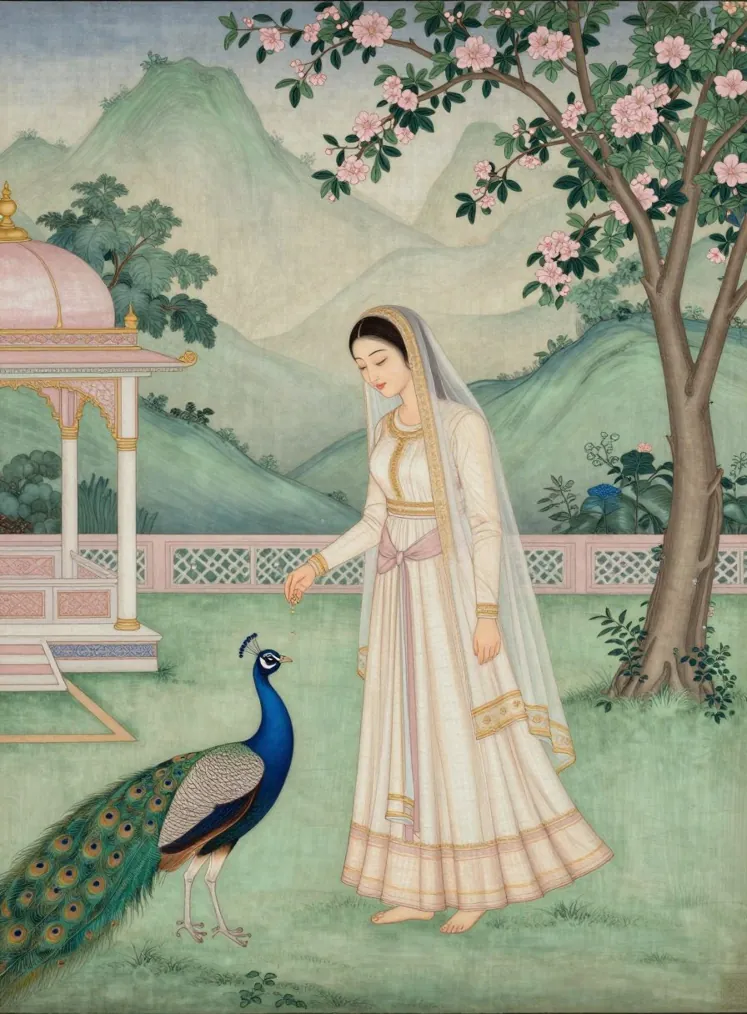
To see the difference, we asked KamZour’s painter for the same scene twice: a young woman feeding peacocks in a palace garden, with a pavilion and a flowering tree. The words of the scene were identical. Only the style description changed.
- In Basohli: a flat green ground, a hot red pavilion, a saffron-yellow dress, heavy dark outlines and large almond-shaped eyes. Space is compressed; the picture is a bold pattern.
- In Kangra: pale green hills recede into mist, the pavilion becomes a delicate pink and white, the dress is ivory, and the woman bends softly toward the bird. Space opens out; the picture becomes a mood.
How does KamZour describe a style?
In words, the way an art historian would. Every style in the KamZour library, which now holds more than a thousand, from Madhubani and Pahari to ukiyo-e, manga and modern art, is written up as a short description of its visual grammar. A description names where and when the tradition belongs, and then what it is recognised by:
- Medium and surface: for Kangra, delicate opaque pigment.
- Palette: pastel and jewel colour harmony.
- Line and figure: fine, lyrical contour drawing, graceful slender figures and soft modelling of the face.
- Composition and space: lush, layered green landscapes, poetic atmospheric distance and flowing, romantic composition.
Placing a style among its neighbours
A good description also says how a style differs from its closest relatives, because that is where recognition lives. Our Kangra card puts it this way: compared with the more forceful stylisation of Basohli and the comparatively restrained naturalism of Guler, Kangra is especially fluid, atmospheric and landscape-conscious. Our Basohli card, in turn, speaks of saturated colour, compressed space, assertive outlines and large almond-shaped eyes.
Saying what it is good for
Each card also suggests what the style suits (Kangra, for romantic and narrative scenes, portraits and landscape) and carries a note of honesty: a picture made in the manner of Kangra is a contemporary reimagining, and should never be presented as an authentic historical Kangra miniature.
What happens when you paint in a style in the Studio?
You bring the idea; the style brings the language. In Imagine, you describe a scene or a feeling in your own words, choose a style from the style library, and pick a shape. The Studio writes your idea out as a detailed scene and joins it to the style’s written description, and KamZour’s painter paints from the two together. The scene we wrote appears beneath your picture in your private Session Library, so you can always read exactly what was painted. Our page on how Imagine works explains each step.
Because the style is a description rather than a copy of any particular painting, it travels. A Kangra description can paint a monsoon evening in Mumbai, a grandmother’s garden or a scene no eighteenth-century painter ever saw, and still speak the language of the hills. Every picture on this page carries a button that opens the Studio with its style already chosen, so you can try it yourself.
Why does describing a style carefully matter?
Because a style carries the memory of the people who made it. The Kangra manner is the work of named families, of Pandit Seu, Manaku, Nainsukh and their sons, who spent lifetimes refining it. Describing it carelessly, as ‘Indian-looking’, would erase them.
So we try to write each description with respect for its tradition: its real place and period, its real materials, the subjects its painters loved. And every picture made in a traditional style follows our Community Standards, including showing sacred figures the way their own traditions show them. To see where this all begins, read The Painters of Kangra and our essay on the sixty-four arts.
Frequently asked questions
What defines an art style?
An art style is a consistent set of choices in medium, palette, line, composition and subject, repeated until the work is recognisable at a glance. Kangra painting, for example, is defined by cool, lustrous colour, fluid line, delicate faces and lush green landscape.
What is the difference between Basohli and Kangra painting?
Basohli, the earliest Pahari school, uses blazing colour, bold outlines, compressed space and strong symbols. Kangra, which flourished later in the eighteenth century, uses cool, fresh colour, fluid drawing, softly shaded faces and deep, atmospheric landscape.
Who were the most famous Pahari painters?
Among the best known are the brothers Manaku and Nainsukh (c. 1710–1778), sons of Pandit Seu of Guler. Nainsukh painted for Raja Balwant Singh of Jasrota, and his family workshop carried the style into the nineteenth century.
How does KamZour turn a traditional style into something I can use?
Each style is written up as a description of its medium, palette, line, figures and composition, and how it differs from related styles. When you choose it in the Studio, your idea is written out as a scene and joined to that description, and KamZour’s painter paints from both.
Is a picture made in the Kangra style a real Kangra painting?
No. It is a contemporary picture made in the manner of Kangra, and it should never be presented as an authentic historical miniature. Real Kangra paintings were made by hand in hill-court workshops, mostly in the eighteenth and nineteenth centuries.