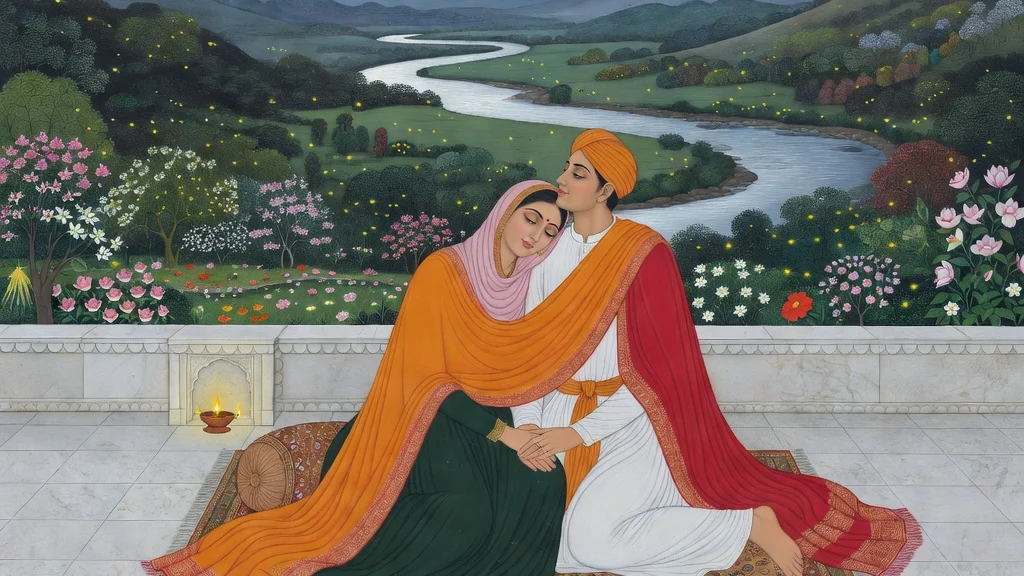
The Kama Sutra is less a book about bodies than a book about people: how they learn, dress, court, marry, quarrel and make up. Its fame rests on one book out of seven.
What is the Kama Sutra, really?
The Kama Sutra is an ancient Sanskrit treatise on kama, a word that means desire, love and the pleasure of the senses. It was written by a man named Vatsyayana, probably in the third century CE, as a guide to a pleasurable, cultivated and balanced life. Sex is one of its subjects, but only one.
A sutra is literally a thread: a string of short, dense statements meant to be memorised and then unpacked by a teacher. Wendy Doniger, who co-translated the text, calls the real book one about “the art of living”: finding a partner, marriage, power within a relationship, and pleasure in all its forms.
The text defines its subject broadly. In the 1883 English translation, kama is “the enjoyment of appropriate objects by the five senses of hearing, feeling, seeing, tasting, and smelling, assisted by the mind together with the soul.” Music, perfume, a well-kept garden and good conversation all belong to it.
The numbers make the point. By its own account the work has about 1,250 verses in thirty-six chapters, arranged in seven books. Only one of those books, ten chapters out of thirty-six, is about physical love. The other six deal with everything around it.
Who was Vatsyayana, and when did he write?
Vatsyayana Mallanaga is accepted as the author because his name is built into the text’s closing verse, but almost nothing else is known about him. He probably wrote in a city of north India; Pataliputra, today’s Patna in Bihar, is one likely candidate.
Estimates of the date range from 400 BCE to 300 CE. Doniger argues for the second half of the third century CE: the text mentions the Abhira and Andhra dynasties, which did not rule side by side before about 225 CE, yet says nothing of the Gupta Empire that came next.
Vatsyayana presents his book as a digest of older works by earlier teachers, such as Babhravya and Dattaka, none of which survive. He also says why he wrote: in the 1883 rendering of his closing lines, the treatise was composed “for the benefit of the world, by Vatsyayana, while leading the life of a religious student at Benares, and wholly engaged in the contemplation of the Deity.”
He adds that “This work is not to be used merely as an instrument for satisfying our desires.” Whatever one makes of that, it shows how he wanted to be read: as the teacher of a discipline, not a supplier of thrills.
Why is the Kama Sutra so misunderstood?
Because most of the world met it through one Victorian translation, and then through fragments of that. The first English version, printed in 1883 and known by the name of the explorer Sir Richard Francis Burton, was issued secretly, passed around underground and pirated for decades. Its fame came from the chapters on sex, and the rest of the book faded from view.
The pattern repeated itself a century later. In the early 1990s the chapter on sexual positions from Indra Sinha’s 1980 translation began circulating on the internet as a text of its own, and today it is often taken for the whole Kama Sutra. A treatise on the whole of a pleasurable life was reduced to a list.
Pictures did the rest. The original is prose and verse; the paintings reproduced everywhere as “Kama Sutra illustrations” were made more than a thousand years later, most in the late eighteenth and nineteenth centuries. The temple couples of Khajuraho and Konark, often labelled “Kama Sutra sculptures”, belong to a different art, made centuries later for other purposes.
So is it the most misunderstood text of all time? No one can measure that. But it is hard to think of another classic whose popular image covers so little of what it actually says. The rest of this essay opens the book itself: its seven books, its place for pleasure among the aims of life, its cultivated citizen, what it says about consent, and how translators and artists reshaped it.
✦ Members-only · opening soon
Continue reading with Collector
The rest of this story, with all its paintings, is for Collector members and above. Membership opens soon. Sign in, and you'll be among the first to read it.
Still to come
- What do the seven books of the Kama Sutra actually cover?
- Where does kama sit among the aims of life?
- Who was the nagaraka, and why did he need sixty-four arts?
- What does the Kama Sutra say about courtship, marriage and consent?
- How did the 1883 translation turn it into a “sex manual”?
- What did modern translations correct?
- Was the Kama Sutra illustrated, and is Khajuraho its picture book?
- Why does reading the Kama Sutra rightly matter for Indian art?
Frequently asked questions
Is the Kama Sutra only about sex?
No. Only one of its seven books, ten of its thirty-six chapters, is about sexual union. The rest covers the aims of life, the sixty-four arts, the daily life of a cultivated citizen, courtship, marriage, courtesans and personal adornment.
Who wrote the Kama Sutra, and when?
It is attributed to Vatsyayana Mallanaga, about whom very little is known. Scholars have dated it anywhere between 400 BCE and 300 CE; Wendy Doniger places it in the second half of the third century CE, probably in north India.
Why do people think the Kama Sutra is a sex manual?
Mainly because of the 1883 English version published under Richard Burton’s name, which was printed privately to evade obscenity law, widely pirated and in places mistranslated. Later, one chapter on sexual positions circulated online on its own and was taken for the whole book.
Which English translation of the Kama Sutra should I read?
For a modern scholarly version, look at Wendy Doniger and Sudhir Kakar’s 2002 translation for Oxford World’s Classics, translated from the Sanskrit with excerpts from two commentaries. S. C. Upadhyaya’s 1961 translation is an older, respected alternative. The 1883 version is historically important but unreliable.
Are the Khajuraho sculptures illustrations of the Kama Sutra?
No. Most Khajuraho temples were built between about 885 and 1000 CE, centuries after the Kama Sutra, and sexual themes make up less than a tenth of their sculpture. The temples and the text share a view of kama as a proper aim of life, not a common script.
References and further reading
- Project Gutenberg: The Kama Sutra of Vatsyayana (1883 English translation)
- Wikipedia: Kama Sutra
- Wikipedia: Vatsyayana
- Literary Hub: Wendy Doniger, “Redeeming the Kamasutra” (excerpt on the Burton translation)
- Books & Ideas: Denis Matringe, “The Kamasutra and its Audiences” (2016)
- Internet Archive: Kamasutra, translated by Wendy Doniger and Sudhir Kakar (Oxford World’s Classics, 2002)
- Wikipedia: Khajuraho Group of Monuments
- Wikipedia: Konark Sun Temple