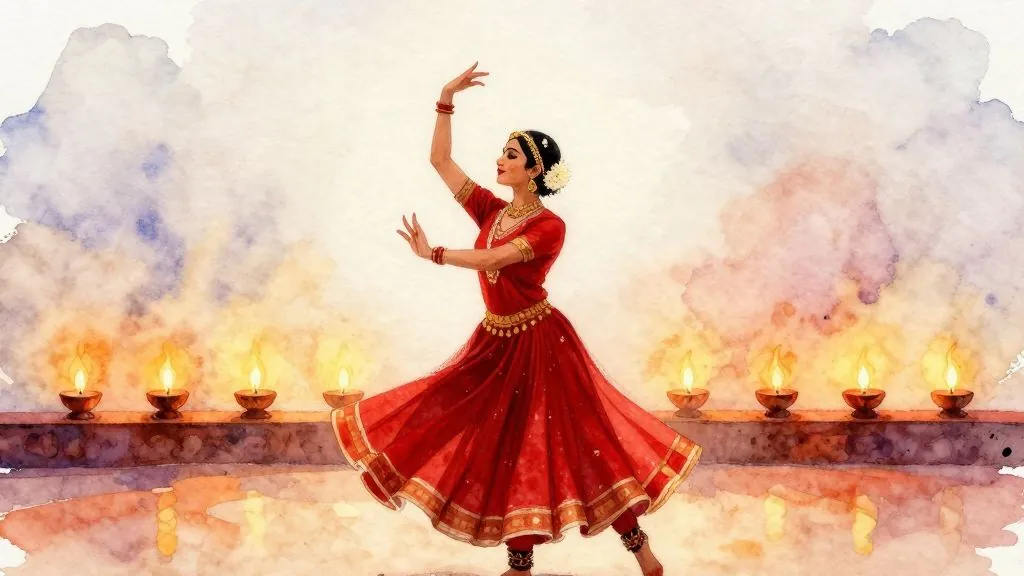
Rasa is not the feeling in the artwork. It is the flavour that the artwork awakens in you.
What is rasa in Indian art?
Rasa is the emotional taste a work of art leaves in the person who experiences it. The Sanskrit word means juice, essence or flavour, and the metaphor is deliberate: just as a meal has a taste that belongs to no single ingredient, a play, a dance or a painting has a feeling that is more than the sum of its parts. Rasa is that feeling, as the audience savours it.
The idea matters because it moves the centre of art from the object to the viewer. A painting of lovers is not simply a picture of love; it is successful when it awakens the flavour of love in you. For about two thousand years, Indian poets, dancers, musicians and painters have measured their work by that standard.
Where does the theory of rasa come from?
It comes from the Natya Shastra, the great Sanskrit treatise on the performing arts. Tradition attributes it to the sage Bharata Muni, though the actual author is unknown, and its first complete compilation is dated to between about 200 BCE and 200 CE. The most studied version runs to 36 chapters and roughly 6,000 verses, covering everything from stage building and music to gesture, costume and acting.
Rasa theory is set out in chapters six and seven, alongside the bhavas, the emotional states that actors portray. Chapters eight to thirteen, on the craft of acting, show how to put the theory to work, which is why the Natya Shastra has remained a working manual for dancers and actors rather than a museum piece.
How does rasa work?
Bharata’s answer fits in a single sentence, often called the rasa sutra: rasa is produced from a combination of determinants, consequents and transitory states. Put more simply, a work of art arranges causes, signs and passing moods so skilfully that an emotion rises in the audience as a whole flavour.
The ingredients
- **Vibhava, the determinants:** the causes and setting of an emotion, such as the beloved, a moonlit garden or the monsoon.
- **Anubhava, the consequents:** the visible signs of feeling, such as a glance, a gesture, a tremor or tears.
- **Vyabhicharibhava, the transitory states:** the passing moods that colour the main one, such as anxiety, hope or shyness.
- **Sthayibhava, the lasting emotion:** the steady feeling underneath, such as love, sorrow or wonder, which the other ingredients bring to the surface as rasa.
The cook’s analogy
The Natya Shastra explains this with food. Just as the taste of a dish is made from vegetables, spices, sugar and salt, yet is tasted as one flavour, the audience tastes the dominant emotion produced by all the elements of a performance together. A good artist, like a good cook, combines ingredients so that nobody notices the recipe, only the taste.
A worked example
Picture a miniature of a heroine waiting at night for her beloved. The vibhavas are the setting: a moonlit terrace, a bed strewn with flowers, a lamp burning low. The anubhavas are the signs on her body: a glance toward the door, a hand at her cheek. The vyabhicharibhavas are the moods that flicker across the scene, hope, then anxiety, then hope again. Beneath them all lies the lasting emotion of love, and what the viewer tastes is Shringara in its mood of longing. Our essay on the eight heroines follows this heroine and her sisters through Indian painting and dance.
What are the eight rasas?
Bharata named eight rasas, each rooted in a lasting emotion and, in later tradition, each given a presiding deity and a colour:
- **Shringara, love and beauty.* From rati, love. Deity: Vishnu. Colour: shyama*, a deep dark hue.
- **Hasya, laughter.** From mirth. Deity: Shiva. Colour: white.
- **Raudra, fury.* From krodha*, anger. Deity: Rudra. Colour: red.
- **Karuna, compassion.* From shoka*, sorrow. Deity: Yama. Colour: grey.
- **Bibhatsa, disgust.* From jugupsa*, aversion. Deity: Mahakala. Colour: blue.
- **Bhayanaka, terror.* From bhaya*, fear. Deity: Kala. Colour: black.
- **Vira, heroism.* From utsaha*, energy. Deity: Indra. Colour: bright white.
- **Adbhuta, wonder.* From vismaya*, astonishment. Deity: Brahma. Colour: yellow.
Why love comes first
Shringara heads the list, and it became a favourite rasa of Indian poets and painters. It is the flavour of love in all its moods, from the first glance to longing in separation to the joy of reunion. Our history of love in Indian art follows it from temple stone to painted page.
What is the ninth rasa, shanta?
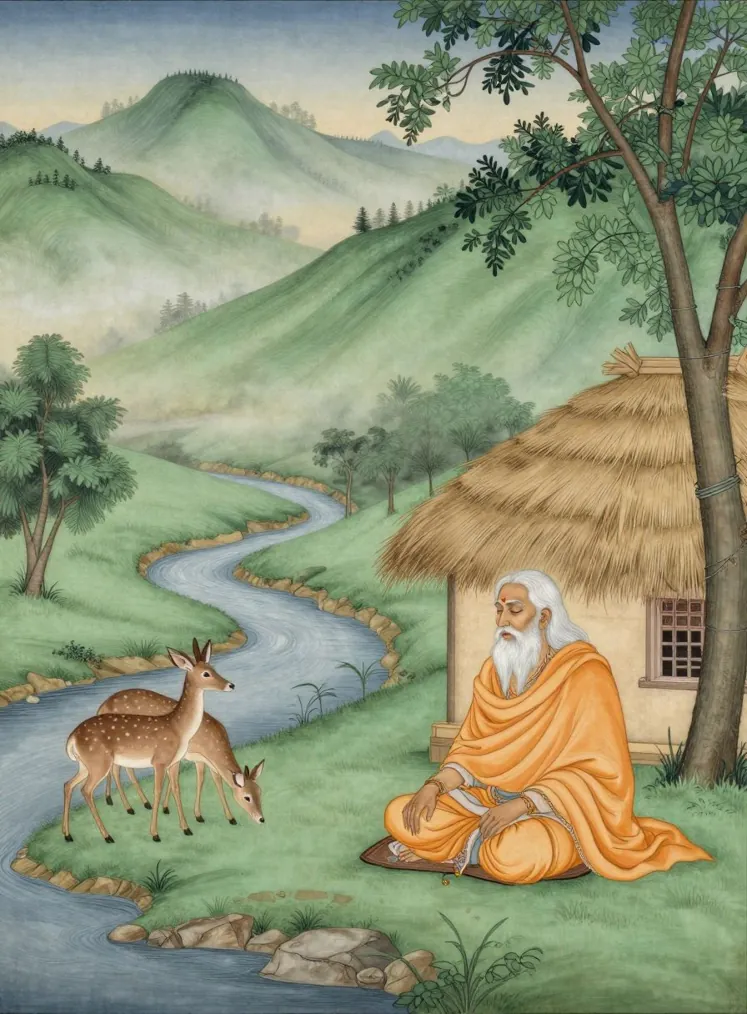
The ninth rasa is Shanta, peace or tranquillity. It is not in Bharata’s original list of eight. Later thinkers argued that the calm of a mind at rest, which the religious and philosophical literature of India so often describes, should count as a rasa too. The idea met resistance, and it took several centuries, roughly between the sixth and tenth, before Shanta was widely accepted. Its colour is sometimes given as a perpetual white.
With Shanta added, the rasas became the navarasa, the nine rasas, the form in which most people meet the idea today. It is a lovely addition: a reminder that art can move us toward stillness as well as toward excitement.
Why does sad art feel beautiful?
Because rasa is not the same as an everyday emotion. The grief of a real loss hurts. The karuna we feel watching a tragedy is somehow savoured, even treasured. Indian thinkers spent centuries on this puzzle, and the most influential answer came from Kashmir.
Abhinavagupta (c. 950–1020 CE), a Kashmiri philosopher and spiritual teacher, wrote the Abhinavabharati, the oldest surviving commentary on the Natya Shastra. He argued that in art, emotion goes through a process of universalisation. The sorrow on stage is not my sorrow or your sorrow; it is freed from anyone’s private interest, so the spectator can contemplate it rather than suffer it. The feelings that are awakened are dispositions already present within us, love and sorrow among them, now tasted with a kind of clarity.
For Abhinavagupta, this experience was akin to spiritual experience, because in it we transcend the limits of our narrow selves for a while. He held that rasa is the highest aim of literature. The ideal audience for it is the sahrdaya, literally the person who has heart: a sensitive, prepared viewer who meets the work halfway.
How does rasa appear in Indian dance?
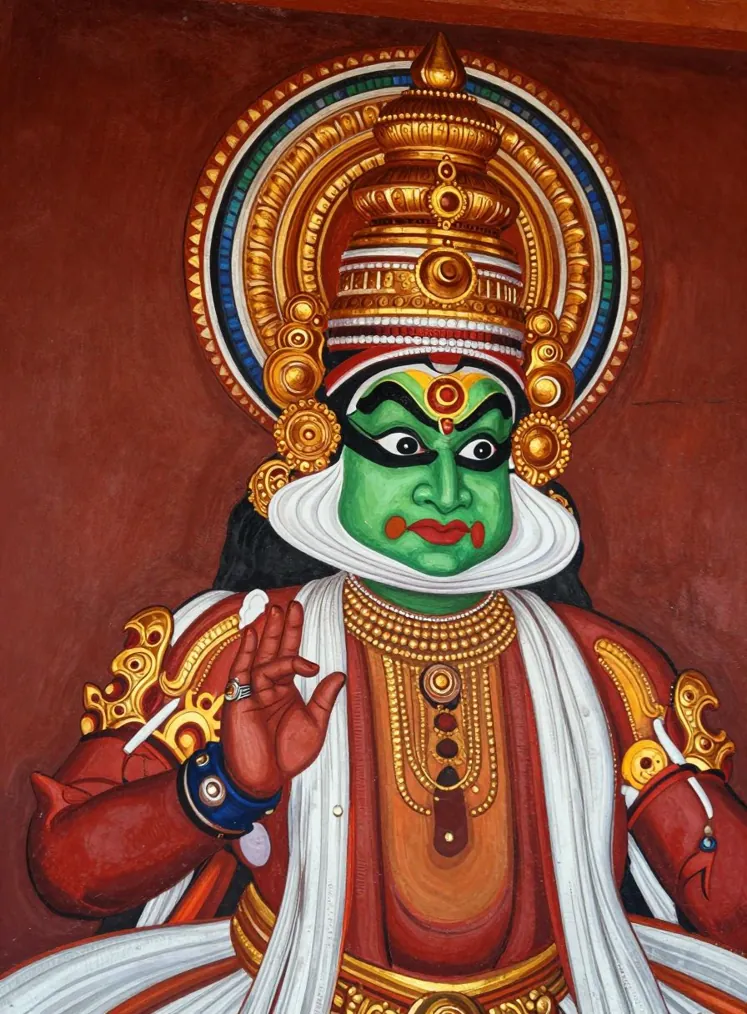
Rasa theory underpins the Indian classical dance forms, including Bharatanatyam, Kathak, Kathakali, Kuchipudi, Odissi and Manipuri, and dancers still train to show each rasa in the face and body.
Kathakali, the dance-drama of Kerala that emerged as a distinct genre in the sixteenth and seventeenth centuries, is the most vivid example. Its actors master nine facial expressions, the navarasa, through training in the control of the facial muscles. Its make-up is part of the language too: pachcha, green, with coral-red lips, marks noble heroes and sages such as Krishna, Rama and Arjuna.
How did rasa shape Indian painting?
Painters took rasa theory from the stage to the page. Rather than simply illustrating stories, many painters set out to paint moods, and the court painters of Rajasthan and the Himalayan hills often worked from poems written to classify feelings.
The Rasamanjari
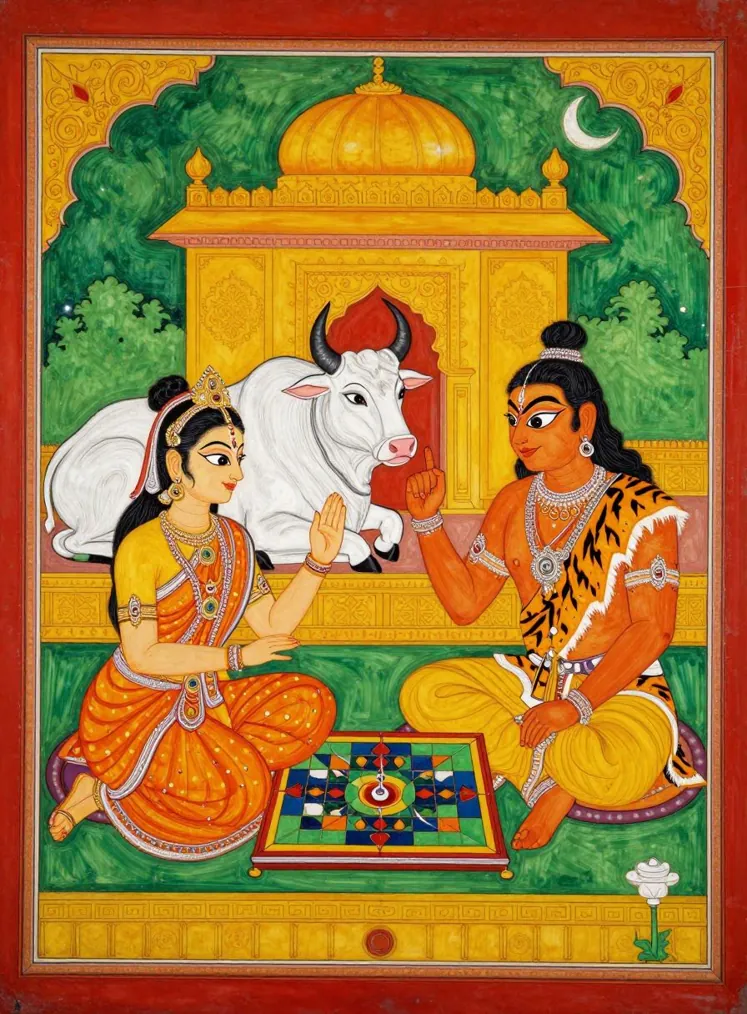
One favourite was the Rasamanjari, ‘the essence of the experience of delight’, a fifteenth-century Sanskrit poem by Bhanudatta devoted to the moods and emotions of the nayaka and nayika, the hero and heroine in love. In 1694–95 the painter Devidasa of Nurpur illustrated it at Basohli, in the hills of Jammu. One of his pages, now in the Metropolitan Museum of Art in New York, shows Shiva and Parvati playing the board game chaupar: Parvati pleads with her husband, who has cheated her of a necklace. The Met notes that the symbolic use of colour and gesture is a signature of Basohli painting of the period.
Love and music in paint
In the eighteenth century the Kangra painters made Shringara their central theme, painting Radha and Krishna in cool, luminous colour; see The Painters of Kangra. Painters also turned musical modes into pictures, each raga shown as a scene with its own mood; see Ragamala: When Music Became Painting. In both, the aim was the same: to make the viewer taste a feeling.
How does KamZour use the idea of rasa?
We borrowed it to organise art by feeling. The Rasa collection in Kama World, on our gallery, is arranged in six rooms, each named after the feeling you want rather than the subject or the style: Love (shringara), Joy (hasya), Tenderness (karuna), Wonder (adbhuta), Courage (vira) and Peace (shanta). You choose what you want to feel, and the art finds you.
We left out fury, disgust and terror on purpose. They are real rasas, and great art has used them, but the Rasa collection is meant to be a place to rest and delight. When you make your own picture in the Studio, Imagine, you can start the same way: describe a feeling rather than a thing, choose a style from the style library, and let the painting find its flavour. Our philosophy explains why we care about this old question at all.
Frequently asked questions
What does rasa mean?
Rasa is Sanskrit for juice, essence or taste. In Indian aesthetics it means the emotional flavour that a work of art awakens in the person who experiences it, such as love, laughter, compassion or wonder.
What are the nine rasas?
The nine rasas, or navarasa, are Shringara (love), Hasya (laughter), Karuna (compassion), Raudra (fury), Vira (heroism), Bhayanaka (terror), Bibhatsa (disgust), Adbhuta (wonder) and Shanta (peace). The first eight come from the Natya Shastra; Shanta was added later.
Who created the theory of rasa?
It is first set out in the Natya Shastra, a treatise on the performing arts attributed to the sage Bharata Muni and dated to roughly 200 BCE–200 CE. The Kashmiri philosopher Abhinavagupta (c. 950–1020 CE) wrote its most influential interpretation.
What is the difference between rasa and bhava?
A bhava is an emotional state, the feeling a character has and an actor portrays. Rasa is what the audience tastes when those states are skilfully combined. The lasting emotion of love (rati), for example, is savoured by the audience as the rasa of love, Shringara.
Why does Shringara come first among the rasas?
Shringara, the rasa of love and beauty, comes first in Bharata’s list and became a favourite subject of Indian poets, dancers and painters; the Kangra painters made it their central theme. It covers love in every mood, from longing and separation to reunion, which gives artists an unusually wide range of feeling to explore.