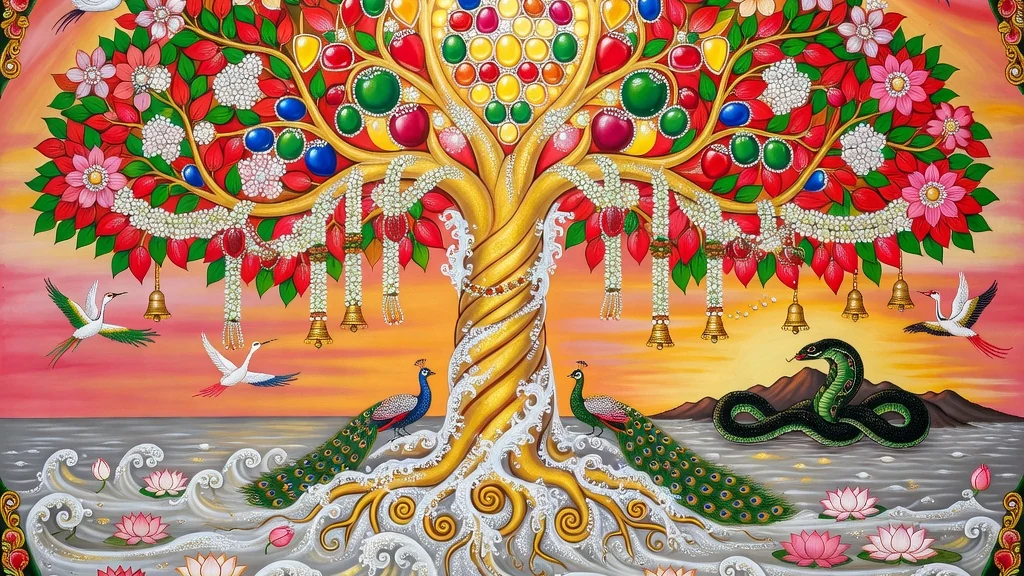
A tree is the most generous thing a village knows. India imagined one that gives everything, and then spent more than two thousand years painting it.
What is the Kalpavriksha?
The Kalpavriksha is the wish-fulfilling tree of Indian tradition: a divine tree that gives whatever is asked of it. It appears in Hinduism, Jainism and Buddhism, and it goes by several names, including kalpataru, kalpadruma and kalpapadapa. The Sanskrit kalpavriksha is usually rendered “aeon tree”, from kalpa, a vast age of the world, and vriksha, tree. Buddhist texts also speak of a ratnavriksha, a jewelled tree.
The idea did not float free of real life. All over India, people give the name Kalpavriksha to real trees that provide for almost every need. The banyan is called Kalpavriksha because it amply provides for human needs, and the coconut because every part of it is useful; regional traditions give the name to the shami of the Rajasthan desert and the mahua of Maharashtra.
That is the key to the tradition. A real tree gives shade, fruit, fuel and medicine and asks for nothing; imagine one that gives everything, and you have the Kalpavriksha. On our homepage we call it simply the wish-fulfilling tree.
Where does the wish-fulfilling tree come from in Hindu myth?
In Hindu myth the Kalpavriksha was born in the Samudra Manthana, the churning of the ocean of milk. Gods and demons churned the ocean together to win amrita, the nectar of immortality, and among the treasures that rose from the waves was the wish-fulfilling tree, which the gods carried off to Indra’s heaven.
The story is told in the Vishnu Purana and, in other versions, in the epics. Mount Mandara was uprooted to serve as the churning rod, and the serpent Vasuki became the rope. Among the treasures that rose:
- Lakshmi, goddess of prosperity, who chose Vishnu as her consort.
- Kamadhenu, the wish-granting cow, and Airavata, the white elephant, whom Indra claimed.
- The Kalpavriksha, taken to Indraloka by the gods.
- Dhanvantari, bearing the amrita, and the deadly poison halahala, which Shiva drank.
What is the Parijata?
The Parijata is one of the heavenly trees that emerged from the churning. Indra’s paradise holds five wish-granting trees, and the Parijata is one of them. Tradition gives it roots of gold, a silver midriff, boughs of lapis lazuli, coral leaves, pearl flowers, buds of gemstones and fruit of diamond. That is why our cover gives it coral leaves and jewel fruit.
The Parijata also has a love story. Krishna is said to have fought Indra to take the tree from his capital, Amaravati, and plant it in his own city of Dvaraka. In a regional telling it was planted by his queen Satyabhama’s door, yet its flowers fell in the garden of Rukmini next door, because of her greater devotion and humility. Today the name Parijata is usually given to the night-flowering jasmine, Nyctanthes arbor-tristis, though the heavenly tree has also been identified with the Indian coral tree.
The tree in Sanskrit poetry
Poets loved its extravagance. In the Meghaduta, “The Cloud Messenger”, written by Kalidasa in about the fourth or fifth century CE, a banished yaksha persuades a passing cloud to carry a message to his wife in the city of Alaka on Mount Kailasa. The poem praises the tree for giving the women of Alaka coloured clothes, flowers for their hair and ornaments.
What does the Kalpavriksha mean in Jainism and Buddhism?
In Jain cosmology the wish-fulfilling trees belong to the beginning of each world cycle, when they give people everything they need. Many accounts count ten trees, each granting one kind of wish: a place to live, garments, vessels, food including fruit and sweets, pleasant music, ornaments, fragrant flowers, shining lamps and a radiant light at night. Some texts describe eight kinds instead.
In the descending half of the Jain time cycle, the avasarpini, the trees’ gifts dwindle across its first three periods, the aras: a picture of an age of ease that slowly fades.
In Buddhism, a little wish-granting tree decorates the top of the long-life vase held by deities of longevity such as Amitayus and Ushnishavijaya. In Myanmar’s Theravada tradition the idea lives on in the annual Kathina, the ritual of presenting robes.
How was the Kalpavriksha shown in early Indian art?
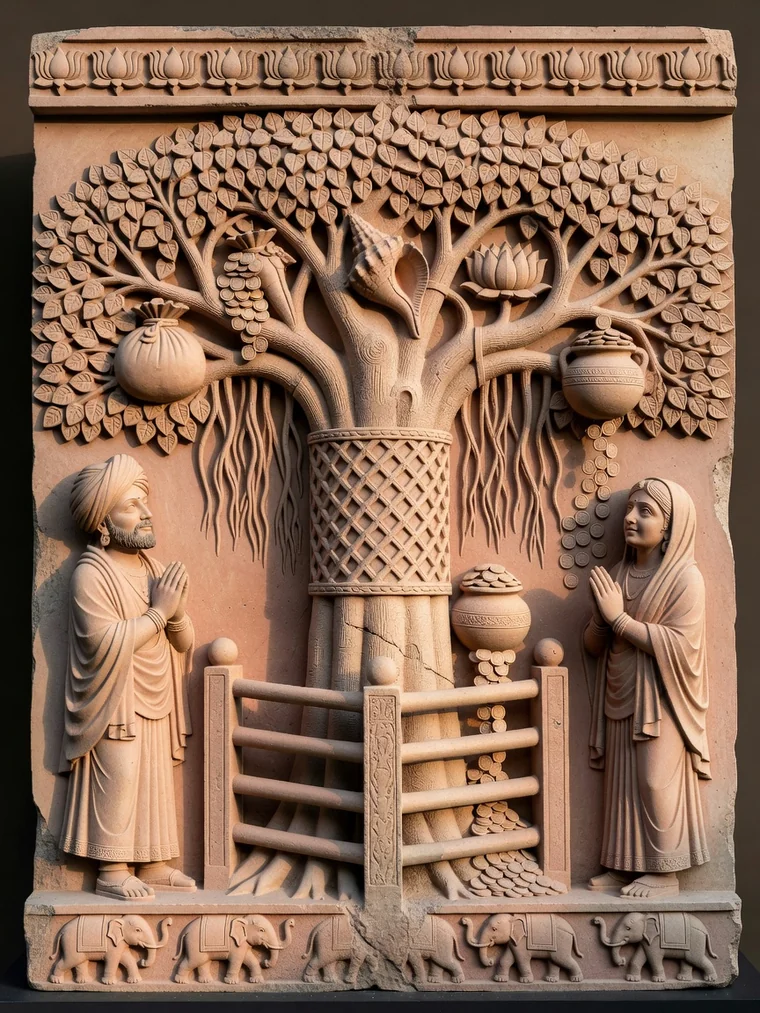
One of the oldest surviving images of the wish-fulfilling tree is a sandstone sculpture from Besnagar, ancient Vidisha, in Madhya Pradesh. The Indian Museum in Kolkata dates it to about the second century BCE (some accounts say the third) and suggests it may have been the capital of a pillar. It stands 172.5 cm tall.
It shows a banyan tree, fenced by a railing at its base and, higher up, by a bamboo fence carved as a network. Its branches bear the tree’s gifts: a purse of coins, a conch shell, a lotus and a vase overflowing with coins. There is no god in sight. The tree itself is the object of reverence, and its generosity is shown in the plainest language a viewer could read: money, and the auspicious conch and lotus.
The motif outlived that early age. An ornamental Kalpavriksha design appears on the reverse of coins and on sculpture of the Gupta period, and the tree kept its place in Indian ornament. Our picture below borrows the Besnagar railing, lattice and purses.
Is the Kalpavriksha the same as the tree of life?
Not quite, but they are close relatives. The tree of life is, in Wikipedia’s words, “a fundamental archetype in many of the world’s mythological, religious, and philosophical traditions”, often linked to immortality or fertility. The Kalpavriksha is India’s own version, and its special stress is on giving: it is a tree that answers wishes.
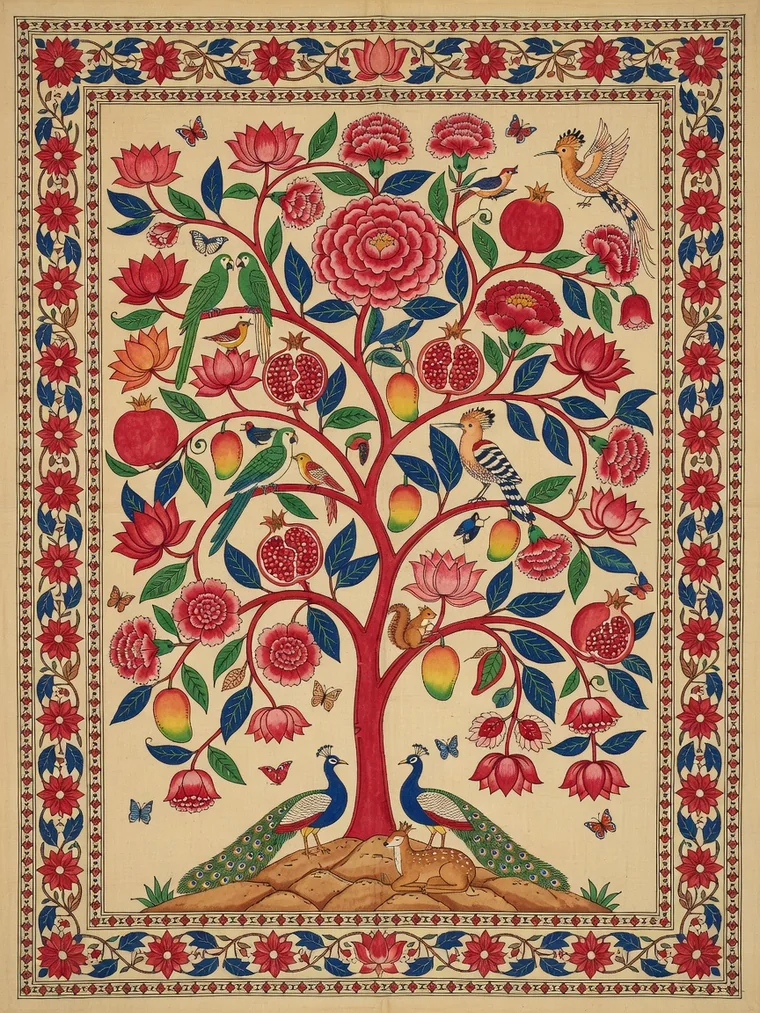
In Indian folk and court art the two ideas meet in one familiar picture: a single great tree at the centre, crowded with birds, flowers and fruit, standing for abundance and life itself.
Kalamkari and the painted cotton of the Coromandel Coast
Kalamkari takes its name from the Persian kalam, pen, and kari, craftsmanship. There are two main schools in Andhra Pradesh. At Srikalahasti the cloth is drawn and coloured freehand with the pen, mostly with scenes from the epics and temple hangings. At Machilipatnam it is printed with carved wooden blocks, using Persian-inflected motifs that include the tree of life. Srikalahasti Kalamkari received Geographical Indication status in 2005 and Machilipatnam Kalamkari in 2008.
The same coast made the great palampores, painted and dyed cotton hangings and bedcovers exported to Europe. One in the Victoria and Albert Museum, made on the Coromandel Coast in about 1770–1780 and more than three metres tall, shows a tree of life with a purple trunk rising from a rocky mound, with flowers, fruit, birds and butterflies in its branches. The V&A notes the Chinese influence in its angular branches, a taste of the European market of the day.
Gond: trees that wake at night
Gond painting grew into a celebrated modern art through Jangarh Singh Shyam (1962–2001), a Pardhan Gond artist from Patangarh in the Mandla district of Madhya Pradesh. Talent scouts from the arts centre Bharat Bhavan found him in 1981, and he became the first Gond artist to use paper and canvas. His lines of coloured dots and fields of dense cross-hatching, inspired by Gond tattoos, founded a school now called Jangarh Kalam.
Trees are at the heart of it. In The Night Life of Trees, a hand-printed book by the Gond artists Bhajju Shyam, Durga Bai and Ramsingh Urveti, trees are busy by day giving shade and food to people and animals, and only at night does their real spirit emerge. That is why the Gond painting on our homepage is set at night.
Madhubani and the miniature painters
In Madhubani, the wedding-chamber paintings are full of living symbols, such as lotus ponds, fish, parrots and peacocks, and contemporary Mithila painters take up the tree of life as a subject in its own right, as Manisha Jha did in her Tree of Life of 2013. We tell that story in Madhubani: The Painted Walls of Mithila.
In court painting the tree is less a symbol than a stage. Radha and Krishna are said to have played in the sweet-scented shade of the kadamba, a tree tied to the pleasant rains that follow the summer. And in Ragamala painting, Hindola raga is shown as a swing: the Philadelphia Museum of Art connects it with the exuberance of the monsoon, when the swing festival is celebrated, and notes that it is usually painted as Krishna being swung by the women of his village. See Ragamala: When Music Became Painting.
Why is the Kalpavriksha at the centre of KamZour’s homepage?
Because a place to make art should work a little like a wish-fulfilling tree. You bring an idea; a picture comes back. On the KamZour homepage a golden tree grows as you scroll, and ten framed paintings hang from its branches. Each opens full size, with a button that takes its style and idea into Imagine, our Studio.
We also wanted it to say something true. The Kalpavriksha gives freely, but the traditions on our branches were built by hand, by generations of painters in Mithila, Patangarh, Srikalahasti and the Warli villages. The tree honours that labour.
One idea, diverse imaginations: what do the swing paintings show?
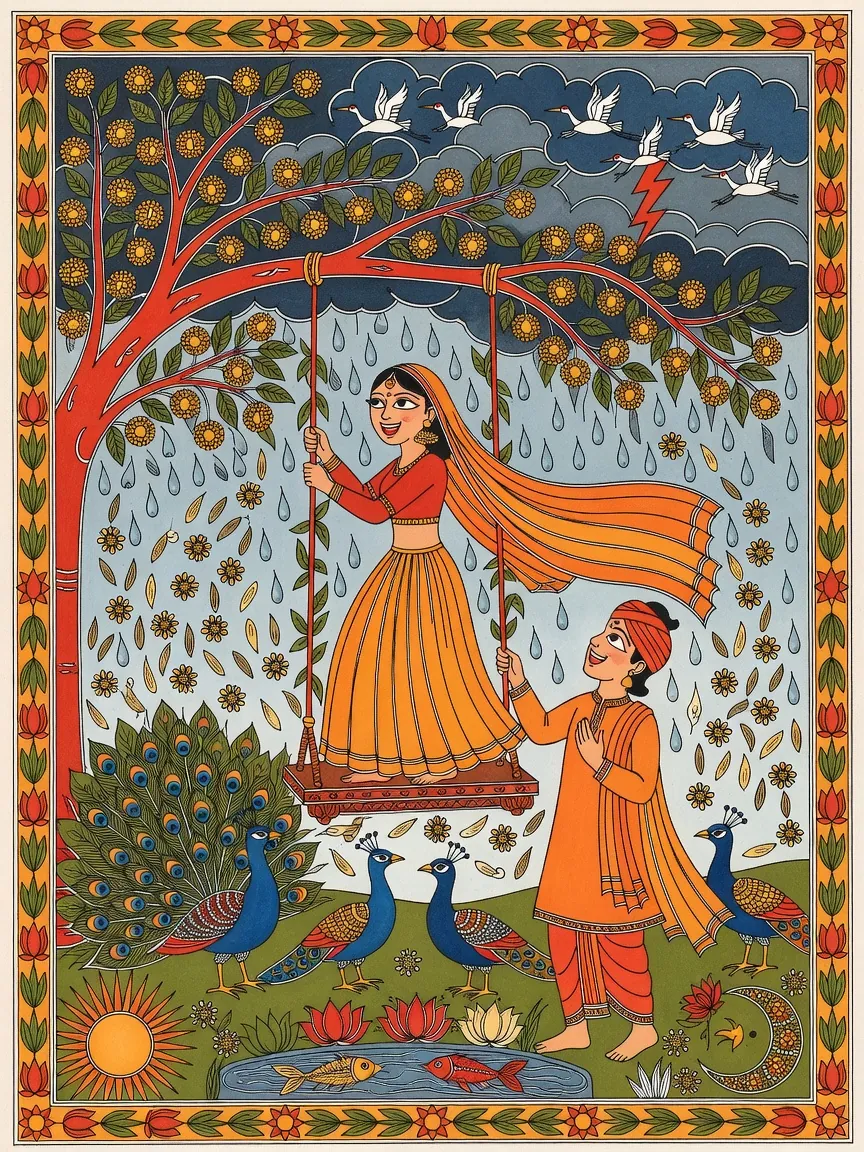
The left branch shows one scene painted in five styles: two young lovers as the first monsoon storm breaks, she flying high on a jasmine-twined swing under a blossoming kadamba, he laughing up at her, peacocks dancing in the rain. We chose it because it is a classic of Indian painting: the swing of Hindola, the kadamba and the monsoon peacocks all belong to shringara, the rasa of love, explained in What Is Rasa?.
We wrote the scene once and let each style stage it. The story never changes; what you notice does:
- Madhubani: the kadamba becomes a flat, red-trunked tree with ranks of patterned blossoms; the figures are drawn in double outlines, and a sun, a crescent moon, a fish pond and a border of flowers fill every gap.
- Ukiyo-e: a heavy branch runs across the top of the print, the rain falls in fine slanting lines over layered blue storm clouds, and a blazing red veil carries the whole diagonal.
- Manga: forked lightning splits the sky behind him, sweeping speed lines curve around the swing, and petals and raindrops fly toward the viewer, turning the moment into pure motion.
- Stained glass: the scene becomes an arched window framed in lotus panes; the lovers glow in ruby and emerald glass, the lightning is a streak of gold, and sunlight spills coloured light onto the stone floor.
- Watercolour: the sky blooms wet-in-wet in indigo and violet, bare white paper becomes the lightning and the rain, and the saffron veil is one luminous stroke.
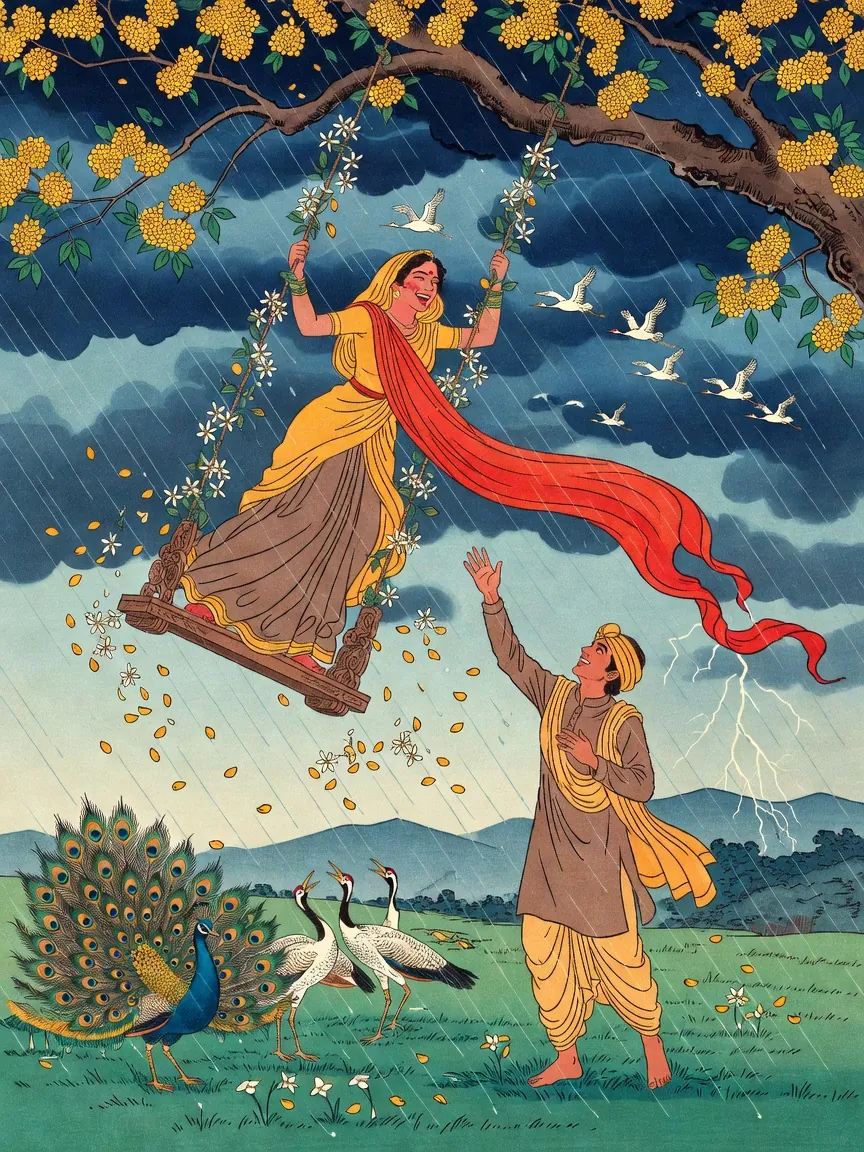
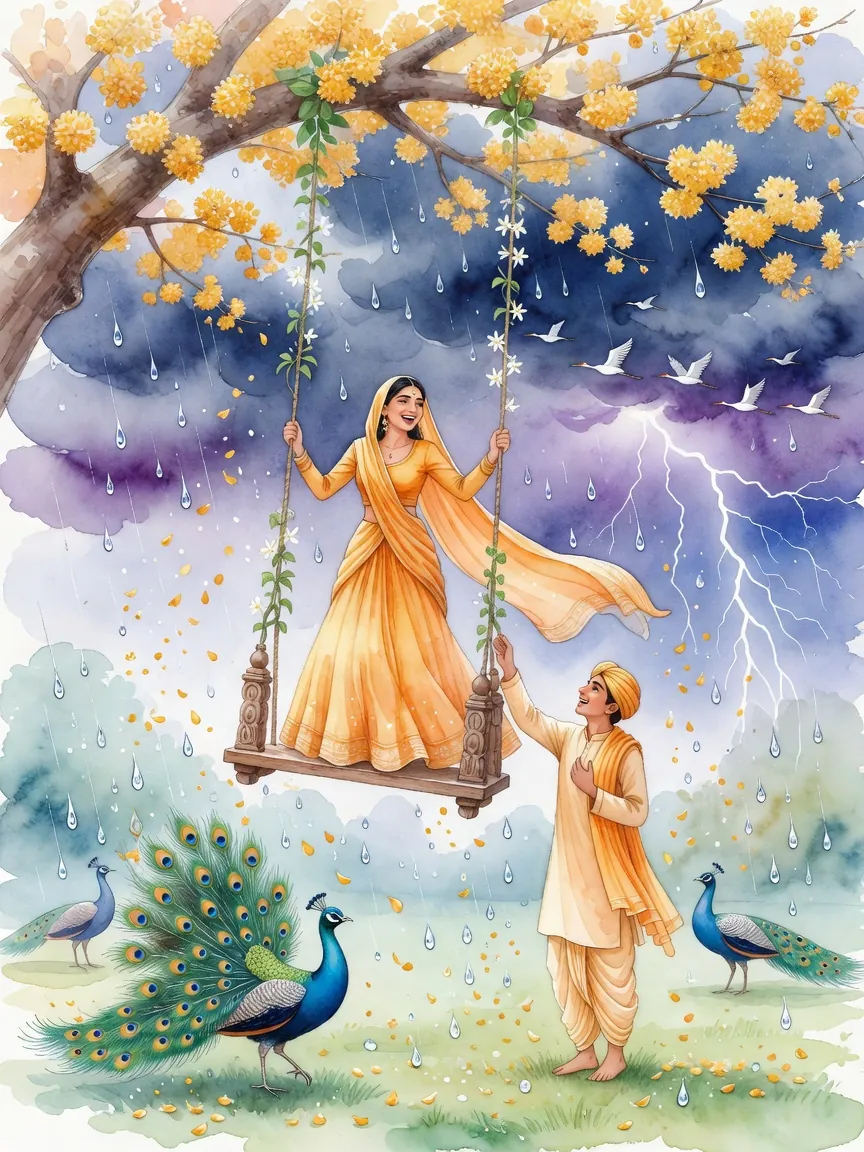
Why show one idea five ways?
Because when subject and mood stay fixed, every difference you see comes from the style itself: its line, its colour, its way of building space. We go deeper into how we describe a tradition in How a Style Is Built, and you can browse all our styles in the style library.
Which traditions hang on the other branch, and why those feelings?
The right branch holds five paintings from five Indian traditions. Each tells a different story, awakens a different rasa, and shows one of the sixty-four arts that Vatsyayana listed as the accomplishments of a cultured life, from singing and dancing to training talking birds; our essay on the sixty-four arts walks through the whole list.
- Gond: the parrot who learned to speak. Under a glowing tree at night, a woman teaches a parrot to speak. The art is shuka-sarika-pralapana, training parrots and mynahs to speak; the rasa is adbhuta, wonder.
- Awadh miniature: a garland on the moonlit terrace. A prince offers a jasmine garland to a princess playing the veena. The arts are music and malya-grathana-vikalpa, the making of garlands; the rasa is shringara, love.
- Bengal Patachitra: the circle dance under the autumn moon. Krishna plays his flute as the gopis, the cowherd women, dance beside the Yamuna. The art is nritya, dance; the rasa is wonder.
- Kalamkari: a portrait for the one far away. A woman paints the face of her absent beloved as a friend comforts her. The art is alekhya, painting; the feeling is longing, love in separation.
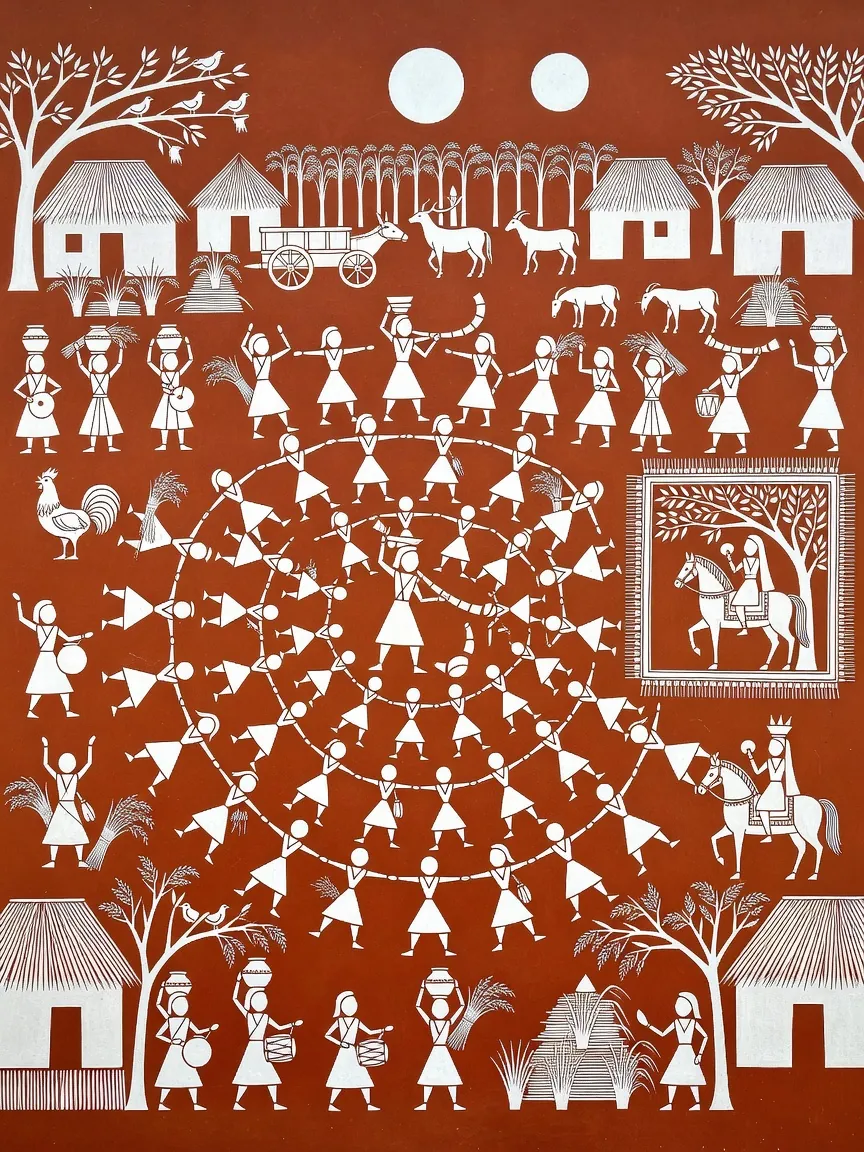
- Warli: the wedding dance at harvest. Dancers spiral around a musician playing the tarpa, a trumpet-like wind instrument, while the bride and groom ride beside them. The art is dance; the rasa is hasya, which our Rasa collection calls Joy.
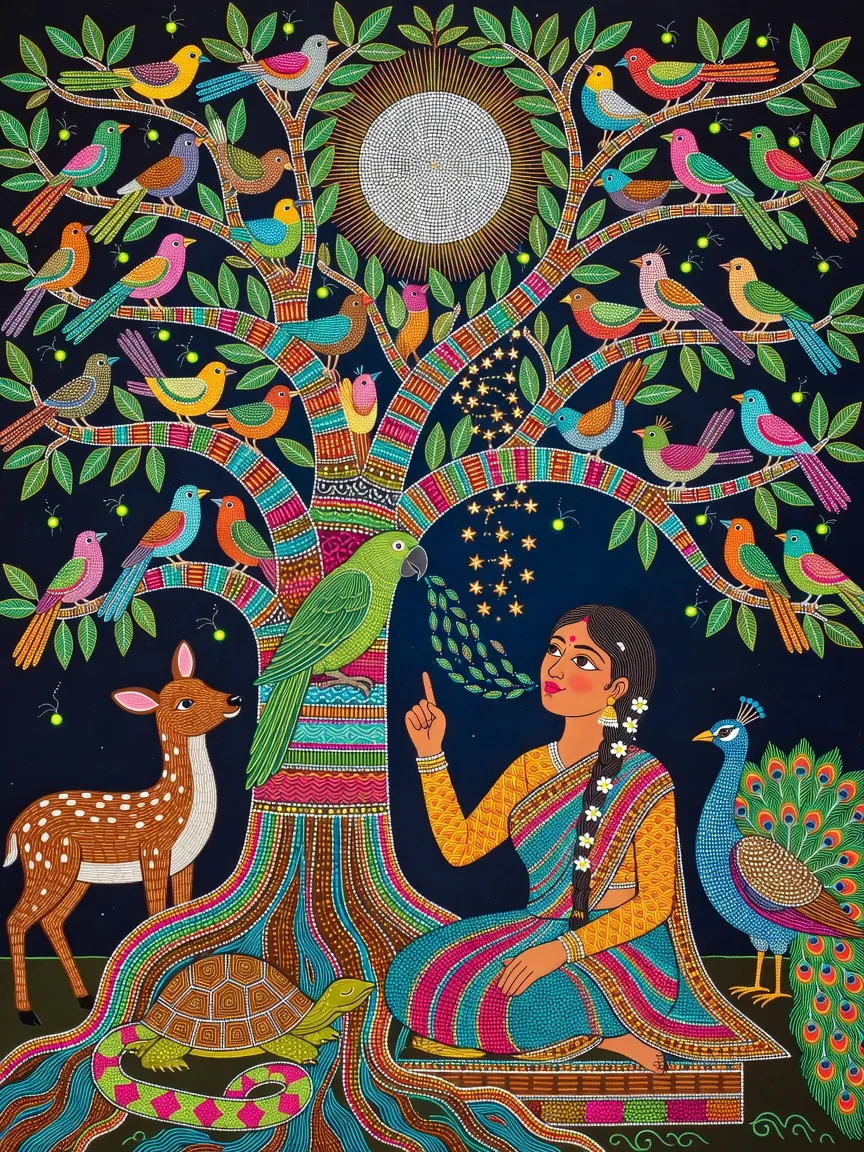
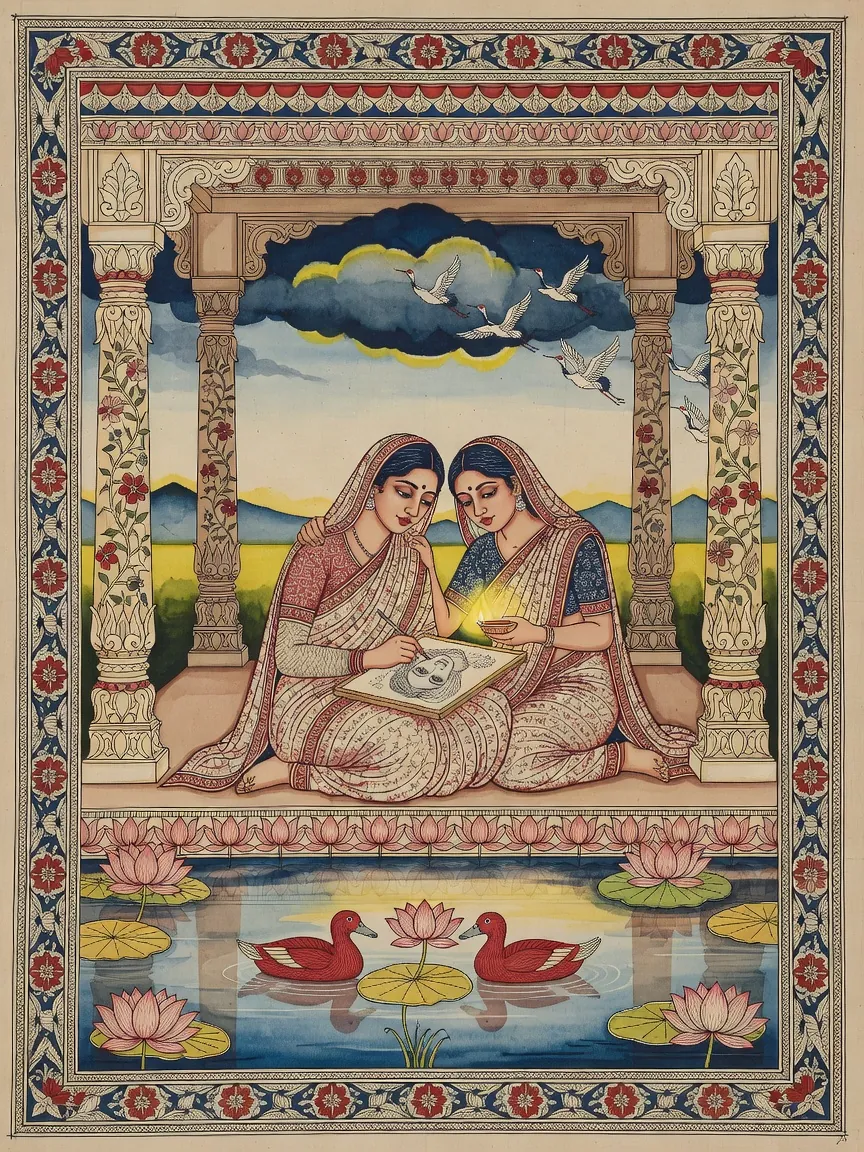
How we matched each story to its tradition
We gave each tradition a story it already knows how to tell. Gond trees wake at night, so the parrot’s lesson happens under one. The patuas of Bengal sing as they unroll their scrolls, and Krishna’s stories are among their great themes, so they tell the Rasa lila, in which, as the Bhagavata Purana tells it, Krishna takes many forms so that every gopi dances with him.
Kalamkari narrates in pen line and natural dye, so it carries the quietest story. Its drifting rain cloud nods to the Meghaduta, where an exiled lover sends his message by cloud; the heroine who pines for an absent beloved is a classic figure of vipralambha, love in separation, one of the moods we trace in The Eight Heroines. Warli painters work in white rice paste on mud walls and paint weddings, farming and village life, and the tarpa dance belongs to that life: dancers circle the musician and follow his lead. So their painting is the most crowded and the most joyful of the five.
How can you paint your own wish-fulfilling tree?
Start with the tradition, not the tree. In Kalamkari it rises from a hillock with a different flower on every branch; in Gond it glows with dots against the night; in early stone it carries purses and a conch instead of fruit. Pick a style, then describe the scene as a painter would: setting, figures, action, light, and where the eye should go first.
Every picture here has a “Make art like this in Imagine” button that opens the Studio with its style and idea ready; nothing is painted until you press Generate. If your tree shelters gods, show them as their own tradition does, as our Community Standards ask.
Frequently asked questions
What does Kalpavriksha mean?
Kalpavriksha is Sanskrit for a wish-fulfilling divine tree, often translated “aeon tree”, from kalpa, a great age of the world, and vriksha, tree. It is also called kalpataru or kalpadruma.
Where did the Kalpavriksha come from?
In Hindu myth it rose from the Samudra Manthana, when gods and demons churned the ocean of milk for the nectar of immortality. The gods took it to Indra’s paradise.
Is the Parijata the same as the Kalpavriksha?
Not exactly. The Parijata is one of the five wish-granting trees of Indra’s paradise, so it belongs to the same family. Krishna is said to have brought it from Indra’s city to Dvaraka. Today the name usually refers to the night-flowering jasmine.
Where can I see an ancient Kalpavriksha sculpture?
The Indian Museum in Kolkata holds a sandstone Kalpavriksha from Besnagar in Madhya Pradesh, dated to about the second century BCE. It shows a railed banyan tree whose branches carry a purse of coins, a conch, a lotus and a vase overflowing with coins.
What is the difference between the Kalpavriksha and the tree of life?
The tree of life is a worldwide symbol of life, fertility and immortality. The Kalpavriksha is India’s wish-fulfilling tree, whose special meaning is generosity. In Indian textiles and folk painting the two often merge.
References and further reading
- Wikipedia: Kalpavriksha
- Wikipedia: Samudra Manthana
- Museums of India (Indian Museum, Kolkata): Kalpavriksha, the Wish fulfilling tree
- Wikipedia: Parijata
- V&A: Palampore, Coromandel Coast, about 1770–1780
- Wikipedia: Kalamkari
- Tara Books: The Night Life of Trees
- Philadelphia Museum of Art: Hindola Raga (Spring Swinging), c. 1700