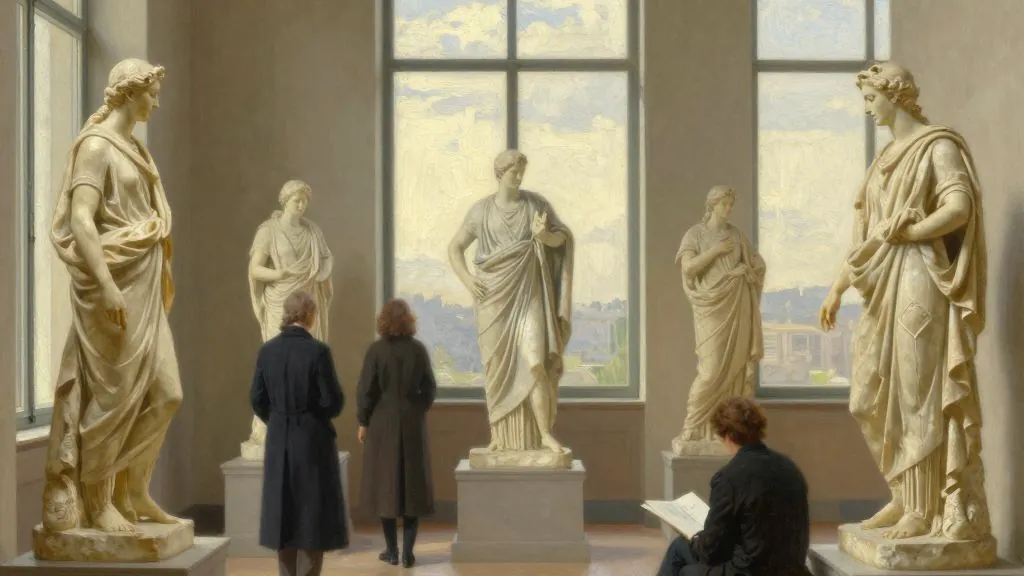
A nude is a body re-formed by art into an idea. The difference between art and pornography lies in purpose, context and treatment, not in the absence of clothes.
What is the difference between naked and nude?
To be naked is simply to be without clothes. A nude is a work of art in which an artist has shaped the human figure into something else: an idea of balance, strength, grace or vulnerability. The distinction is old, but it was made famous by the British art historian Kenneth Clark in The Nude: A Study in Ideal Form, published in 1956 from lectures he gave in Washington in 1953.
Clark opens the book with the contrast. “To be naked is to be deprived of our clothes, and the word implies some of the embarrassment most of us feel in that condition. The word ‘nude,’ on the other hand, carries, in educated usage, no uncomfortable overtone.” The nude, he went on, brings to mind “not of a huddled and defenseless body, but of a balanced, prosperous, and confident body: the body re-formed.”
Clark did not invent the idea, and he did not pretend that art has no sensual charge. His point was narrower and more useful: art can hold feeling, including the pull of beauty, without being obscene, because the artist has turned a particular body into a general form. For Clark, idealisation was the mark of a true nude, as opposed to more descriptive figures that he thought of as merely naked.
Is the distinction still accepted?
Not without argument, and that is healthy. In 1972 the critic John Berger, in the television series and book Ways of Seeing, argued that the European nude often reflected the gaze of a male viewer rather than the woman shown; he suggested that only twenty or thirty nudes in the European oil-painting tradition depict a woman as herself. Later historians, such as Lynda Nead, have asked what the ideal nude leaves out. These debates sharpen the distinction rather than erase it: they are arguments about how the figure is shown, and for whom, which is exactly the question that separates art from exploitation.
Why have artists always studied the human figure?
Because the human body is the hardest and most expressive subject an artist can draw, and learning it teaches proportion, weight, movement and light all at once. The figure has been a central subject of Western art since ancient Greece, where gods and heroes were carved as ideal forms, visions of health and balance meant to stir the mind as well as the senses.
The Renaissance brought the figure back after the Middle Ages. Donatello’s bronze David, probably of the 1440s, is considered the first free-standing nude statue since antiquity, several decades before Michelangelo’s marble David (1501–1504).
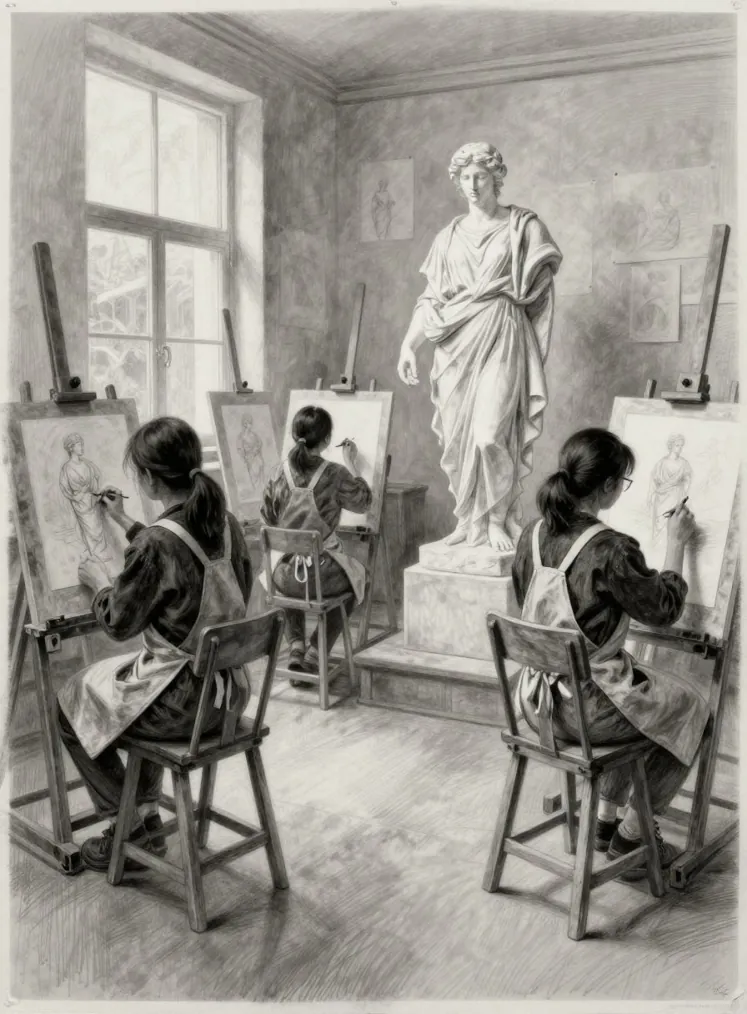
How did the art academies teach it?
In the European academies of the eighteenth and nineteenth centuries, training followed a strict ladder. At the École des Beaux-Arts in Paris, students first copied prints of classical sculpture, then drew from plaster casts of famous statues, and only after passing each stage were they allowed into the class where a live model posed. The resulting studies were simply called académies, and they were the building blocks of a painter’s education.
The same rules that made the life class respectable also kept women out of it for generations. Concerns about propriety meant that most academies excluded women until the second half of the nineteenth century; the École des Beaux-Arts officially accepted women only in 1897, and gave them access to its studios in 1900.
What does figure study look like today?
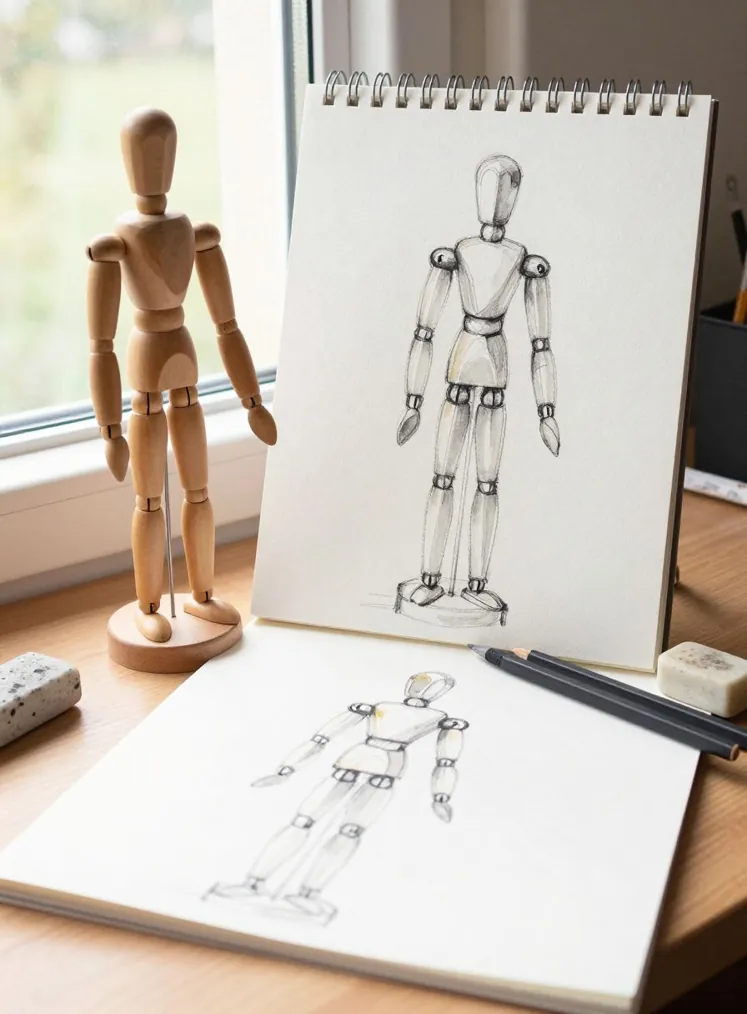
Life drawing, the drawing of the figure from a live model, has been part of the training of Western artists since the Renaissance, and it is still taught in art schools around the world. Artists also learn from wooden mannequins, from anatomy books and from pose-reference sheets. A few rules of thumb have come down through this teaching:
- An average adult is about seven and a half heads tall; an idealised figure is drawn at about eight heads.
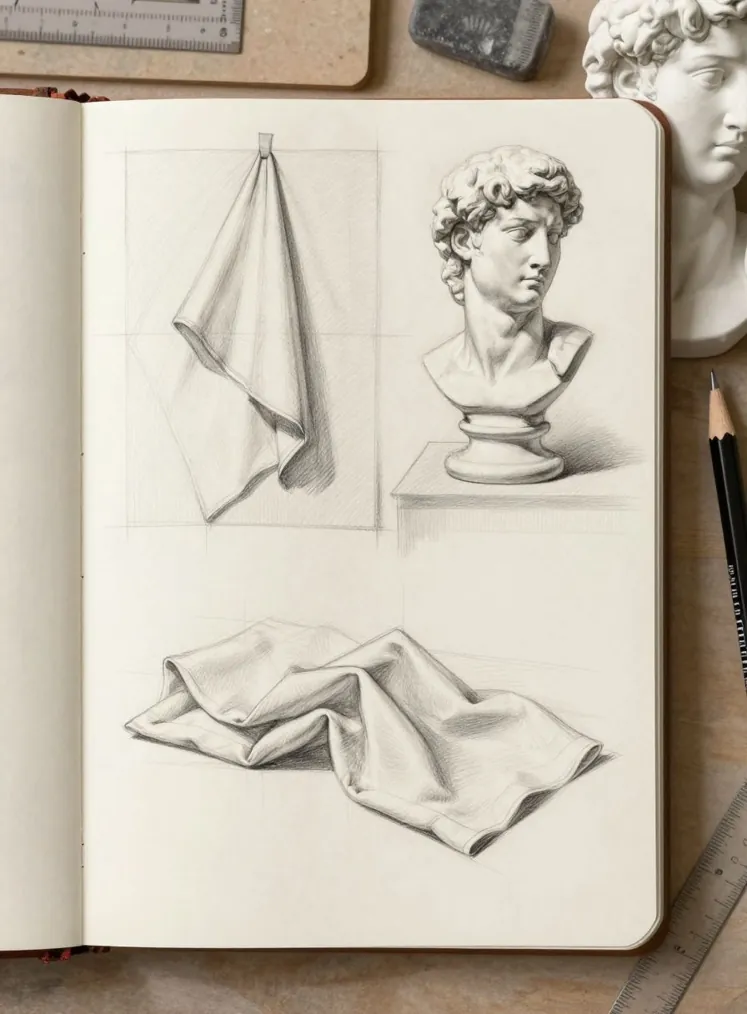
- Drawing drapery, the folds of cloth over a form, is a classic exercise in its own right, because it teaches how light describes a shape.
- Mannequins and plaster casts let a beginner study proportion and perspective before ever working from life.
What makes pornography different from an artistic nude?
The short answer is purpose. Pornography is made to be consumed for sexual gratification; an artistic nude is made to be looked at as form, meaning and history. Museums, art schools, courts and online platforms phrase it differently, but they all ask some version of three questions:
- Purpose: is the subject form, feeling and meaning, or sexual gratification? A figure study is about weight, line and light; its pose is chosen to teach, not to titillate.
- Context: is the work presented as art, study or history, with its title, date, maker and meaning, or is it stripped of context and offered for consumption?
- Treatment and medium: is it a drawing, painting or sculpture that visibly transforms its subject, or an image built to pass as a real person in a real moment?
Why does realism matter so much?
History shows that the line was felt most sharply when a picture stopped looking like an ideal and started looking like a particular, real person. Goya’s The Nude Maja (1797) drew the attention of the Spanish Inquisition in 1815, and Manet’s Olympia (1865) shocked Paris, in part because each showed a specific, contemporary woman rather than a goddess who could be viewed at a distance.
Photography faced the same problem from its invention. Historians of the nude note that photography suffers from being “too real”, and for many years it was not accepted by those committed to the traditional fine arts. That is one reason KamZour draws its own line at the photographic: an artistic medium keeps the distance that makes a figure a work of art, and it can never be mistaken for a real person.
What does Indian law say about nudity in art?
Indian law does not treat nudity as obscene in itself. The leading case is Aveek Sarkar v. State of West Bengal, decided by the Supreme Court of India on 3 February 2014 by Justices K. S. Radhakrishnan and A. K. Sikri. It concerned a magazine photograph of a tennis player and his fiancée, published with an article about their engagement and their protest against racial discrimination.
The court discarded the old Hicklin test, taken from an English case of 1868, which judged material by its effect on the most easily corrupted minds. In its place it adopted a community standards test: a work is judged as a whole, in its context and by the standards of the contemporary community, not by the sensibilities of a hypersensitive few. The court held that a nude or semi-nude picture is not obscene unless it is designed to excite sexual passion, and it found that the photograph carried a message of love and racial equality.
India has a much older tradition of the figure in art, too. At the Khajuraho temples, built around 950–1050 CE, the sculpture includes nude figures, which make up only about a tenth of the decoration; our essay on love in Indian art explains how those carvings fit a whole vision of life. KamZour’s own rules, described below, are deliberately stricter than the law requires.
How do YouTube and Meta treat nudity in art?
The largest platforms both make exceptions for art, and both tie those exceptions to purpose and context.
YouTube’s Nudity & Sexual Content policy says: “We may allow sexual content when the primary purpose is educational, documentary, scientific, or artistic, and it isn’t gratuitous.” It adds, just as plainly, “This is not a pass to promote sexually explicit content,” and it advises creators that context in the title and description helps show the primary purpose. Anything sexual involving minors is never allowed.
Meta’s Adult Nudity and Sexual Activity standard, which covers Facebook and Instagram, says: “We also allow real world art that depicts nudity such as photographs of paintings, sculptures, etc,” sometimes behind a warning screen and age limits. The same standard is strict about new images: it removes AI- or computer-generated images of nudity and sexual activity, and digital imagery, “regardless of whether it looks ‘photorealistic’”.
The lesson for anyone making art online is clear. Platforms protect the painted and sculpted nude of art history; they are wary of newly made digital images, and most wary of anything that could pass as a real photograph. Purpose and context carry weight everywhere, and protecting minors is absolute.
How does KamZour draw the line?
KamZour follows museums and art schools, and then draws its lines more tightly still. Our Community Standards do not allow sexual content, and they restrict nudity to the places where art has always used it:
- Allowed, as museums and art schools allow it: the figure in fine art, such as life drawing, anatomy and pose-reference studies for artists, and figures in the manner of classical painting and sculpture.
- Only in artistic media: drawing, charcoal, ink, paint, sculpture and illustration, presented calmly and without sexual focus.
- Never photographic or photorealistic, and never anything made to pass as a real photograph.
- Never a real person, famous or private, and never a lookalike.
- Never anyone under eighteen, or anyone who could appear to be: these requests are declined outright, never adapted, and accounts that attempt them are closed and reported.
- Sexual intent is draped or declined: when a request goes past these lines, Imagine keeps the idea and adapts only the part that crossed, for example by adding drapery or clothing, or declines it.
How do we know the lines hold?
We test them and publish what we find. In the tests described on How Imagine works, run on 27 September 2026, all 30 attempts to trick Imagine past our rules on nudity were stopped, and all 30 genuine art requests, such as figure studies and sculpture, were written as asked, so the rules do not smother legitimate art. The same page lists, honestly, where our AI can still slip, such as a “figure study” occasionally coming back cropped too close, and what we are doing about it.
Every account is for adults, and nothing anyone makes is published to a public feed: pictures stay in the maker’s private library.
Why do the pictures on this page show no nudity at all?
Because an explanation does not need an example. The Journal is read by everyone, so we illustrate the nude the way a museum might introduce it to a school group: with robed marble, a plaster cast, a mannequin and a sketchbook of drapery. The ideas are the subject here, not the body.
How should you look at a nude in a museum?
Look the way the artist was working: at the pose and where the weight falls, at the line of the contour, at how light turns a surface. Read the label, which gives the title, date, maker and often the story the figure tells. Then ask Clark’s question in your own words: what idea has this body been re-formed into? Courage, grief, grace, the divine? That habit of looking is what our philosophy means by art that deepens human connection, and it is the same habit we hope people bring to the Style Library.
Frequently asked questions
Is nudity in art the same as pornography?
No. An artistic nude is made to be seen as form, meaning and history, in an artistic medium and context. Pornography is made for sexual gratification. Museums, art schools, Indian courts and major platforms all judge the difference by purpose, context and treatment, not by the mere absence of clothes.
Who first distinguished the “naked” from the “nude”?
The distinction was made famous by the art historian Kenneth Clark in The Nude: A Study in Ideal Form (1956), though he did not originate it. Clark wrote that to be naked is to be deprived of our clothes, while the nude, as a work of art, is “the body re-formed”.
Is a nude painting obscene under Indian law?
Not in itself. In Aveek Sarkar v. State of West Bengal (2014), the Supreme Court of India held that a nude or semi-nude picture is not obscene unless it is designed to excite sexual passion, and that a work must be judged as a whole, in context, by contemporary community standards.
Can I make figure studies with KamZour Imagine?
Yes, in artistic media. Imagine can make figure studies, anatomy sheets and pose-reference pages in drawing and painting styles, and figures in the manner of classical painting and sculpture, calm and non-sexual. It never makes photographic nudes, real people or anyone who could be a minor.
Why won’t KamZour make photorealistic nudes?
A photorealistic image can be mistaken for, or used against, a real person, and it loses the distance that makes a figure a work of art. Major platforms such as Meta also treat digital and AI-made nudity far more strictly than paintings and sculptures, so KamZour keeps the figure in clearly artistic media only.
Does YouTube allow nudity in art?
YouTube’s policy says it may allow sexual content when the primary purpose is educational, documentary, scientific or artistic and it isn’t gratuitous, and that context in the title and description helps. It also says this is not a pass for sexually explicit content, and it never allows sexual content involving minors.
References and further reading
- Wikipedia: Nude (art)
- Tate Etc.: The nude stripped bare (David Rimanelli, 2005), quoting Kenneth Clark
- Wikipedia: Academic art (training at the École des Beaux-Arts)
- Wikipedia: Figure drawing
- Wikipedia: Aveek Sarkar v. State of West Bengal
- YouTube Help: Nudity & Sexual Content Policy
- Meta Transparency Center: Adult Nudity and Sexual Activity
- KamZour: Community Standards