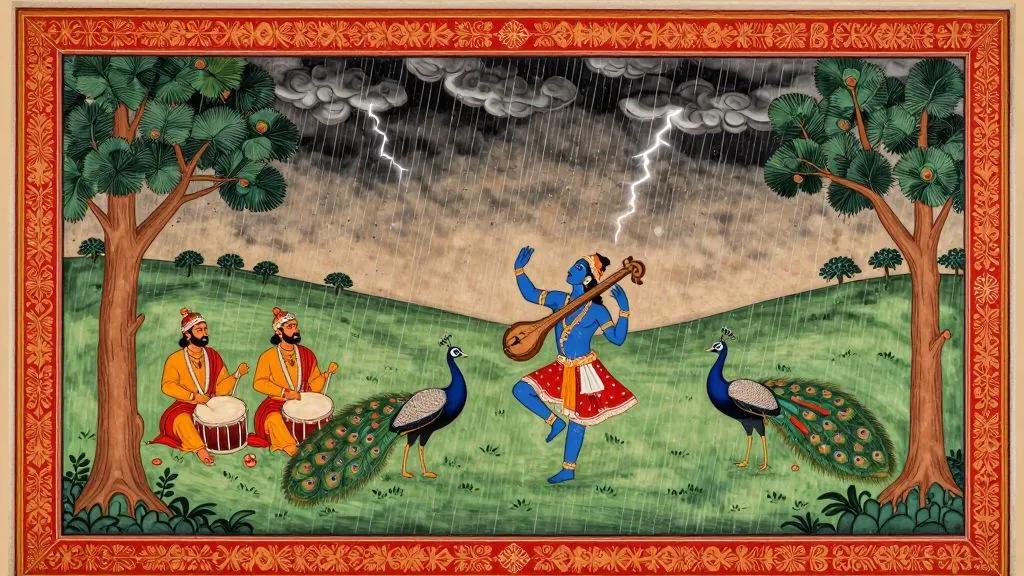
In a Ragamala painting you can almost hear the picture: the rain of Megh, the creak of Hindol’s swing, the vina that calls the deer to Todi.
What is a Ragamala painting?
A Ragamala painting is a picture of a piece of music. More precisely, it shows the mood of a raga, one of the melodic modes of Indian classical music, as a scene with people, a setting and a season. Ragamala means “garland of ragas”, and the paintings were made in sets, one raga to a page, like flowers on a string.
In these paintings each raga is personified with a colour and a mood, and often with a verse describing a story of a hero and heroine (nayaka and nayika). The page also shows the season or the time of day or night when the raga should be sung, and many connect the raga with a deity. They are a classic example of how poetry, painting and music came together in early modern India.
What is a raga, and why can it be painted?
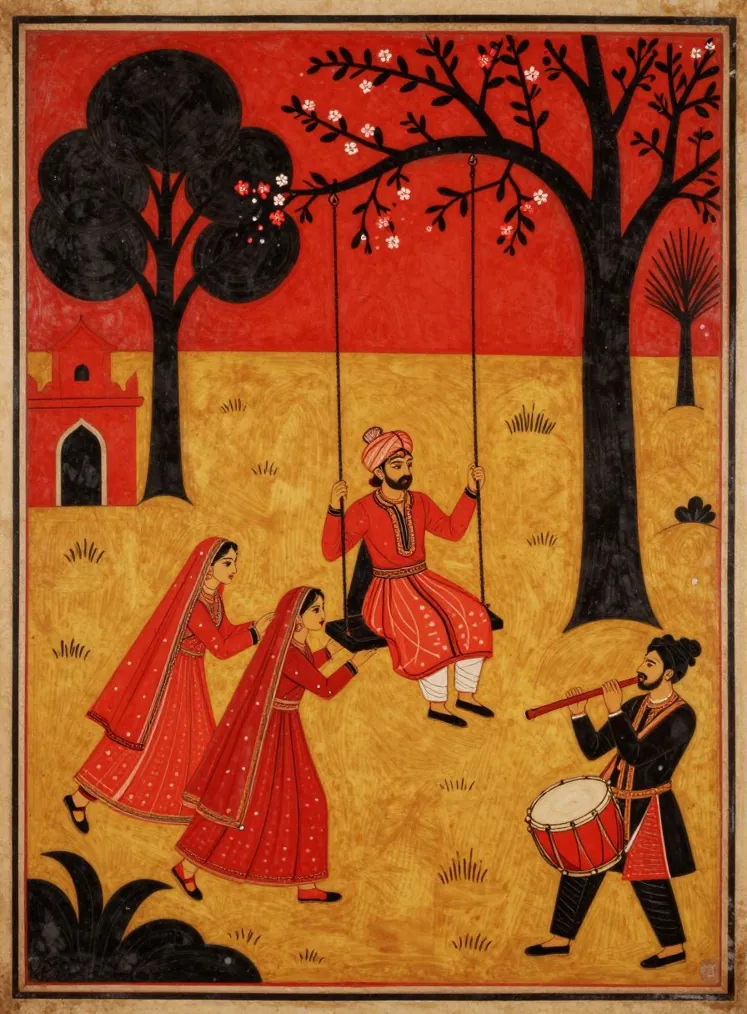
A raga is more than a scale. It is a set of notes and characteristic melodic movements that a musician improvises within, and it is meant to create a particular mood or emotion in the listener. Many ragas also have a proper time or season. Raga Bhairav is a dawn raga; the vocalist Pandit Jasraj described it as a “morning raga, and solemn peacefulness is its ideal mood.” Raga Megh, whose name means “cloud”, belongs to the monsoon. Raga Hindol is linked to spring, and its phrasing imitates a swing, which is what hindola means.
Once a raga has a mood, a season and a time of day, it already has most of a picture. Indian writers took the next step long before the painters. The twelfth-century treatise Sangita Ratnakara is the first to name a presiding deity for each raga, and from the fourteenth century ragas were described in short Sanskrit verses called dhyana, “contemplation”, which pictured each one as a person in a scene. Ragamala painters turned those verses into images.
This is the same idea that runs through Indian aesthetics as a whole: art exists to awaken a rasa, an emotional flavour, in the audience, whatever the medium. Our essay What Is Rasa? explains it.
How are ragas organised into families?
Ragamala sets treat the ragas as a royal household. At the head are six principal, “male” ragas. Each has wives, the raginis, and sons, the ragaputras; some systems add daughters, ragaputris. The six principal ragas usually named are:
- Bhairava, the dawn raga, linked with Shiva.
- Malkaunsa (Malkaus or Malakoshika).
- Hindola, the swing, linked with spring.
- Dipaka, painted with lamps and fire.
- Shri, linked with the goddess.
- Megha, the cloud, linked with the monsoon.
Kshemakarna’s garland of 86
The most widely followed system for painters was compiled in 1570 by Kshemakarna, a priest of Rewa in Central India, in a Sanskrit poem on the Ragamala. In it, each of the six principal ragas has five raginis and eight ragaputras, except Raga Shri, which has six raginis and nine ragaputras, making a family of 86 members. The six ragas were also meant to match the six seasons of the Indian year.
The family could be surprisingly specific. A late-eighteenth-century Pahari painting of Rama Raga in the National Museum, New Delhi, follows Kshemakarna’s system, in which Rama Raga is the third son of Dipak Raga; the system suggests showing him as a gentleman feeding crows in a garden, or as a warrior with bow, arrow and sword leaving the house.
What do Ragamala paintings show?
Each raga or ragini has its own set of images, repeated and varied from school to school, so that a viewer who knew the music could recognise it at once. A few of the best known:
Megh: the monsoon
Megh and its companion Megh Malhar celebrate the joy of the first rains: dark clouds, lightning, falling rain, dancing peacocks and musicians, and often Krishna dancing among them, as in a Megha Malhar painting in the Salar Jung Museum in Hyderabad. It is the subject of this essay’s cover.
Hindol: the swing
Because hindola means swing, Hindol Raga is painted around a swing. Typically, as the Philadelphia Museum of Art describes it, the cowherd god Krishna is “swung by the adoring women of the village”; in that museum’s painting of about 1700, a prince takes his place. A Hindola painting of about 1590–1595 in the National Museum, New Delhi, hangs the swing from a mango tree at the spring festival.
Todi: the deer and the vina
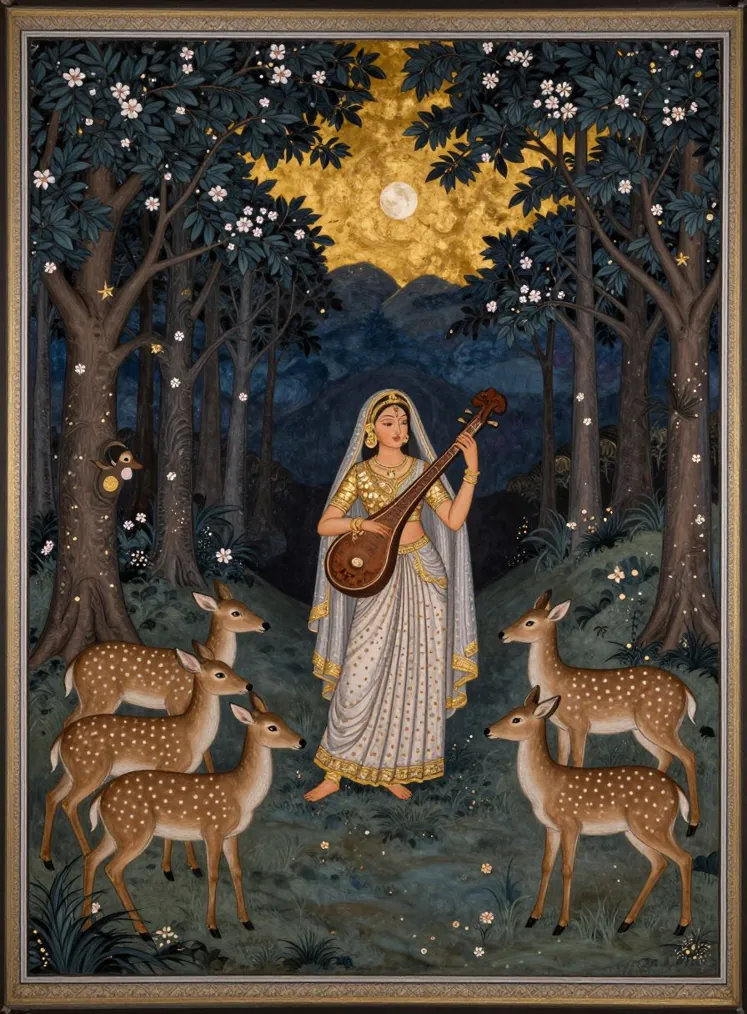
Todi Ragini is nearly always a gentle woman holding a vina in a green forest, surrounded by deer drawn by her music. The sixteenth-century Sangita-Darpana describes her holding the vina and delighting the deer “deep in the forest”. A Salar Jung Museum painting reads Todi as the anguish of separation from a beloved, which is why she plays alone.
Dipak: the lamp
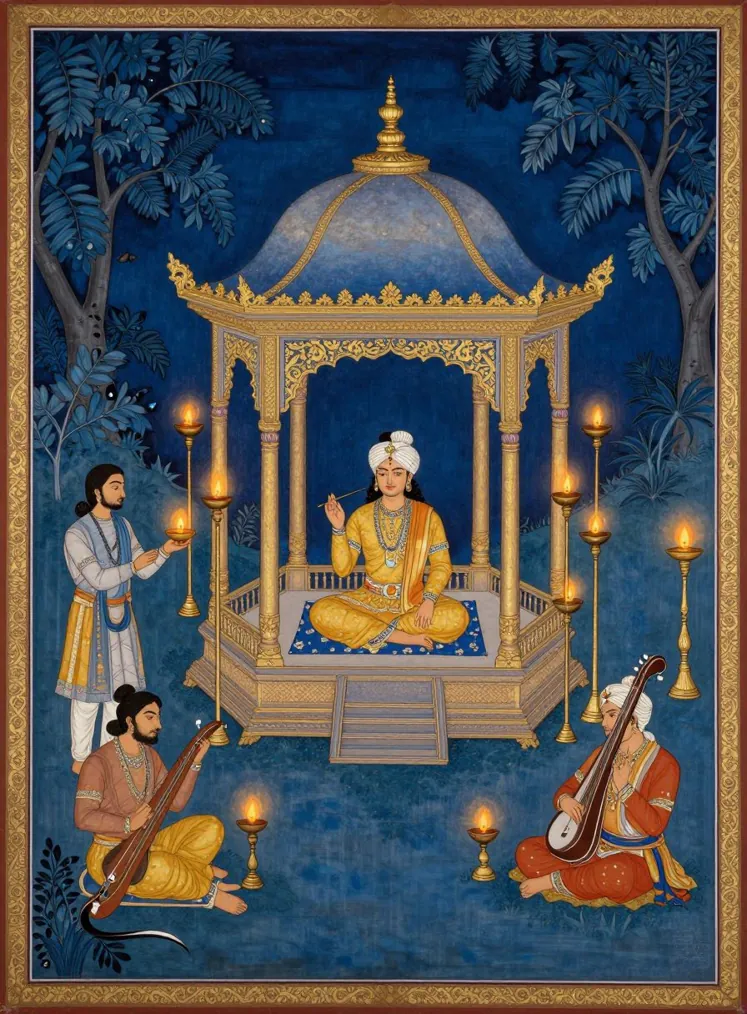
Painters show Dipak Raga with fire and light. A Dipak Raga painted by Jai Kisan at Malpura in Rajasthan around 1756, now in the Harvard Art Museums, sets Krishna and Radha between candelabras lit with many wicks; the museum notes that depictions of Dipak typically include some sort of fire imagery.
Raginis and heroines
Many raginis are painted as heroines in love, which is where the Ragamala meets the eight heroines of Indian poetry. Malasri Ragini in the Chunar Ragamala shows a woman alone in a palace chamber at night, scattering lotus petals as she prepares for her beloved: a mood, the Harvard Art Museums write, of “lonely anticipation”. Music treatises such as the Ragavibodha (1609) even matched particular raginis to particular heroines. See The Eight Heroines.
Where and when did Ragamala painting flourish?
Ragamala painting began in Rajasthan and spread to almost every school of Indian painting between the sixteenth and eighteenth centuries, so today the sets are named by school: Rajput, Deccani, Mughal and Pahari Ragamala. The Salar Jung Museum lists Mughal, Malwa, Datia, Bundi, Kotah, Mewar, Bikaner, Kangra, Basohli, Kullu, Chamba, Bilaspur, Jammu and the Deccan among them. The form flourished under royal patronage in the sixteenth and seventeenth centuries and faded during the nineteenth. Some landmarks:
- The Chunar Ragamala (1591). Painted at Chunar in present-day Uttar Pradesh and dated February 1591, by three Mughal-trained painters, Shaykh Husain, Shaykh Ali and Shaykh Hatim, for Rao Raja Bhoj Singh of Bundi. The set was later taken to Bundi in Rajasthan, where, the Smithsonian’s National Museum of Asian Art notes, it became the compositional model for ragamalas painted there over the next 200 years. Folios are now in Washington, Cambridge (Massachusetts), London and Varanasi.
- The Chawand Ragamala (1605). Painted by Nasiruddin (also called Nisardin) at Chawand in Mewar, it is credited as the earliest dated set of Rajasthani miniature paintings, and it is inscribed with the artist’s name.
- Sahibdin’s Ragamala (1628). Sahibdin, a Muslim painter who worked for Hindu patrons at the Mewar court and is one of the few painters of the period whose name survives, painted a Ragamala in 1628 that is now in the National Museum, New Delhi.
- The Deccan. At Bijapur, Sultan Ibrahim Adil Shah II (r. 1580–1627) was a passionate musician and patron of music, and the Deccani courts produced Ragamalas of dreamlike colour; a Gauri Ragini probably from Ahmadnagar, about 1575–1600, is in the Los Angeles County Museum of Art.
- The hills and beyond. Pahari painters in Kangra and neighbouring courts painted Ragamalas into the late eighteenth and early nineteenth centuries, and sets discovered in Odisha use the Pattachitra style and the ragas of Odissi music.
Why does Ragamala still matter?
Because it is one of the most complete ideas any artistic tradition has had about the senses. A single Ragamala page holds a poem, a melody and a picture, and asks the viewer to feel one through the others. It is an old answer to a question every artist still asks: how do you make someone feel something they cannot directly see or hear?
It also shows how a tradition travels. A Sanskrit poem written by a priest in Rewa, a set painted by Mughal-trained artists at Chunar, a model copied for two centuries in Bundi, a Muslim painter illustrating Hindu music for a Rajput king: the Ragamala was made by exchange, and each school gave the same melodies its own accent.
How can you paint a raga yourself?
Start the way the old painters did, with the music’s mood, season and time of day, not with its notes. In Imagine, pick a miniature style from the Style Library, such as Deccani Miniature, Malwa Miniature, Kota Painting or Kangra Painting, and describe the scene: “a woman playing a vina to the deer in a moonlit forest”, or “a pavilion full of lamps at night”. Each picture in this essay carries a button that opens the Studio with its style and idea ready. To see how we describe a tradition so that a painter can follow it, read How a Style Is Built.
Frequently asked questions
What does Ragamala mean?
Ragamala means “garland of ragas”. It is a series of Indian miniature paintings, each showing the mood of one raga, or musical mode, often with a descriptive verse above the picture.
What are raginis and ragaputras?
In Ragamala systems the six principal ragas are imagined as heads of families. Their wives are the raginis and their sons the ragaputras. In Kshemakarna’s system of 1570, each raga has five raginis and eight ragaputras, except Shri, which has six and nine, making 86 in all.
What are the six main ragas in Ragamala painting?
Bhairava, Malkaunsa, Hindola, Dipaka, Shri and Megha. They were meant to correspond to the six seasons of the Indian year, and each has its own imagery, such as rain clouds for Megha and a swing for Hindola.
What are the earliest dated Ragamala sets?
Among the earliest is the Chunar Ragamala, dated February 1591, painted at Chunar in Uttar Pradesh by Mughal-trained artists for Rao Raja Bhoj Singh of Bundi. The Chawand Ragamala of 1605, painted by Nasiruddin in Mewar, is credited as the earliest dated set of Rajasthani miniature paintings.
Where can I see Ragamala paintings?
The National Museum in New Delhi holds Sahibdin’s 1628 Ragamala and Pahari examples; the Salar Jung Museum in Hyderabad, the Harvard Art Museums, the Smithsonian’s National Museum of Asian Art, LACMA and the British Museum hold notable folios, and many can be viewed online through Google Arts & Culture and museum collection sites.
References and further reading
- Wikipedia: Ragamala paintings
- Google Arts & Culture: A Closer Look at the Raga Rama (National Museum, New Delhi)
- Google Arts & Culture: Colour Meets Sound (Salar Jung Museum)
- Smithsonian National Museum of Asian Art: Kedar Ragini from the Chunar Ragamala
- Harvard Art Museums: Malasri Ragini, from the Chunar Ragamala
- Harvard Art Museums: Dipak Raga, Malpura, c. 1756
- Philadelphia Museum of Art: Hindola Raga (Spring Swinging), c. 1700
- Wikipedia: Todi (raga)