In Indian thought, love was not a distraction from a good life. It was one of its four aims, and so it became one of art’s great subjects.
Why is love such an important subject in Indian art?
Love is central to Indian art because classical Indian thought treated it as a legitimate aim of life. The tradition names four aims (purusharthas): dharma, right conduct; artha, prosperity; kama, love and delight; and moksha, liberation. None was to be pursued at the cost of the others, but none was shameful either. Art that celebrated kama was therefore celebrating part of a good and complete life.
That outlook runs through Indian aesthetics too. The Natya Shastra, the ancient treatise on theatre, names eight rasas, the emotional flavours a work of art awakens, and the first of them is Shringara, the rasa of love. For centuries, poets, sculptors, painters and dancers returned to it more than to any other. Our essay on what rasa is explains the idea in depth.
It also helps to remember what the Kamasutra, compiled by Vatsyayana around the third century, actually is. Much of it is a guide to a cultivated life: the house of a person of taste, the day’s pleasures, and the sixty-four arts such a person should learn. Love, in this view, is one art of living among many.
What is the mithuna, and why does it appear on sacred buildings?
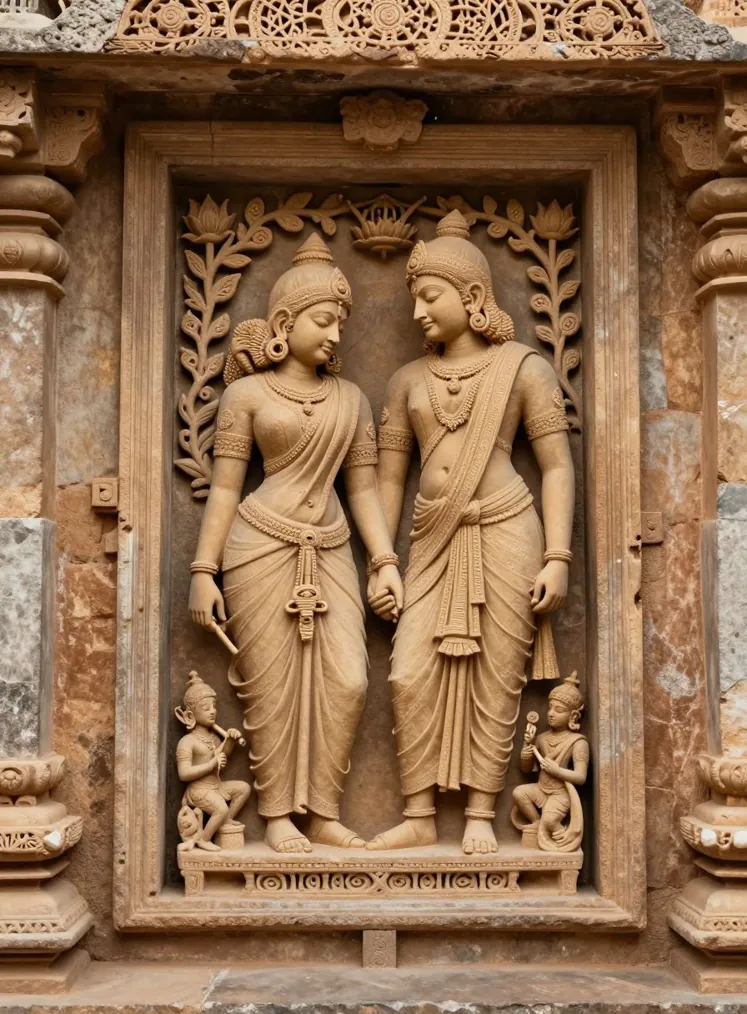
A mithuna is a sculpted loving couple. It is one of the oldest and most widespread motifs in Indian art, and it was considered auspicious: it was placed on door jambs, gateways, railings, pillars and entrances, where it was believed to bring good fortune and protection.
The motif appears on early terracottas and at Buddhist sites and stupas from as early as the Shunga period (187–75 BCE) and into the first centuries CE, long before the great Hindu temples. Over time it came to carry a deeper meaning: the union of opposites, and the reconciliation of worldly enjoyment (kama) with spiritual liberation (moksha). A couple at a temple doorway, in this reading, is a picture of wholeness at the threshold of the sacred.
What do the Ajanta cave paintings show about love?
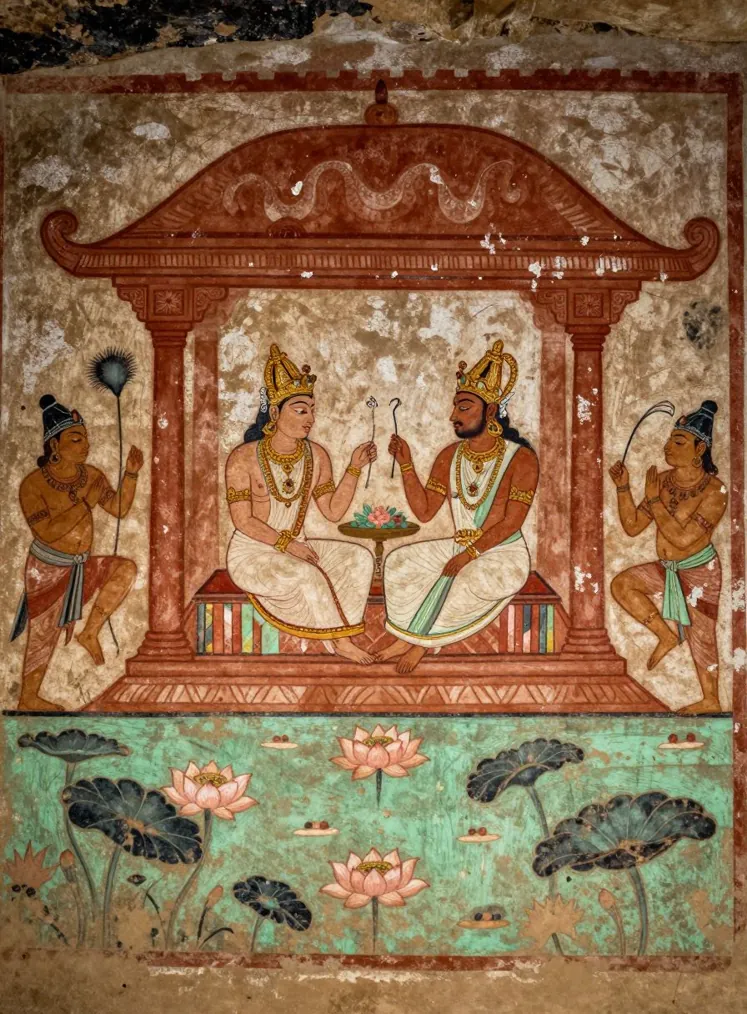
The Buddhist caves of Ajanta in Maharashtra hold some of the oldest surviving paintings in India, made in two phases: the second century BCE to the first century CE, and again around 460–480 CE. They have been a UNESCO World Heritage Site since 1983.
Ajanta’s murals mostly tell the Jataka tales, stories of the Buddha’s previous lives, and they do so by painting the whole world around those stories: palaces, processions, musicians and royal couples. Love here is part of courtly and everyday life, painted with the same grace as the famous bodhisattva Padmapani beside the shrine. The murals were painted as dry fresco, on a dry plaster surface.
Why are there couples on the temples of Khajuraho?
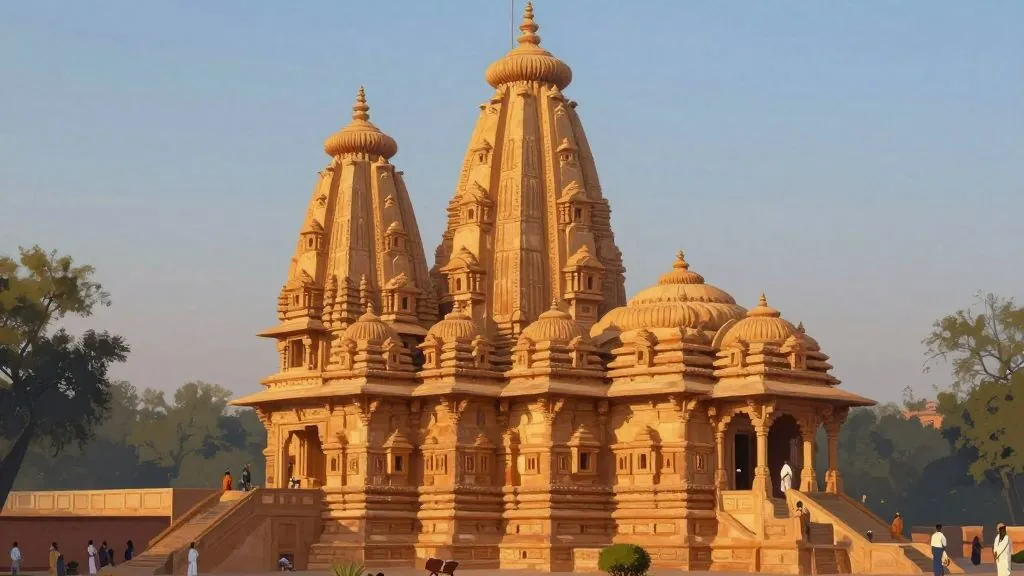
The temples of Khajuraho in Madhya Pradesh were built by the Chandela dynasty; most of the surviving ones were completed between about 970 and 1030 CE. Of the roughly 85 temples that stood by the twelfth century, about 25 survive, and since 1986 they have been a UNESCO World Heritage Site.
Khajuraho is famous for its sculptures of couples, but they are a small part of the whole: scenes of love make up only about a tenth of the carvings. The rest show gods and goddesses, celestial dancers, musicians, warriors, animals and daily life. Scholars offer two main explanations for the couples:
- Kama as part of life. In the Hindu tradition, kama is an essential and proper part of human life, and the temples picture life in its fullness, with spiritual liberation as its goal.
- A lesson for householders. Another reading holds that the carvings helped students, who lived apart in hermitages, learn about the worldly role of the householder they would one day take on.
What does the Sun Temple at Konark show?
At Konark on the coast of Odisha, King Narasimhadeva I of the Eastern Ganga dynasty built a temple to the sun god Surya around 1250 CE. The whole temple is carved as a colossal chariot, with twenty-four stone wheels nearly 3.7 metres across, drawn by seven horses. It has been a UNESCO World Heritage Site since 1984.
Its walls are a whole world in stone: musicians and dancers, deities, scenes of daily life (women wringing their wet hair, looking from a window, playing with pets) and, among them, couples in love. The sculptors treated all of these as belonging together, as parts of the life the sun shines on.
How did poets and painters imagine divine love?
The most beloved love story in Indian art is that of Radha and Krishna, and its great text is the Gita Govinda.
The Gita Govinda (12th century)
In the twelfth century the poet Jayadeva composed the Gita Govinda in Sanskrit: a song-poem in twelve chapters about Krishna, Radha and the gopis, the cowherd women of Vrindavan. It tells of longing, separation and reunion, and it is traditionally read as an image of the soul’s love for the divine. Unusually for its time, it names the raga and tala, the melody and rhythm, for each song, which is why it is still sung and danced today.
The painters of the Himalayan hills
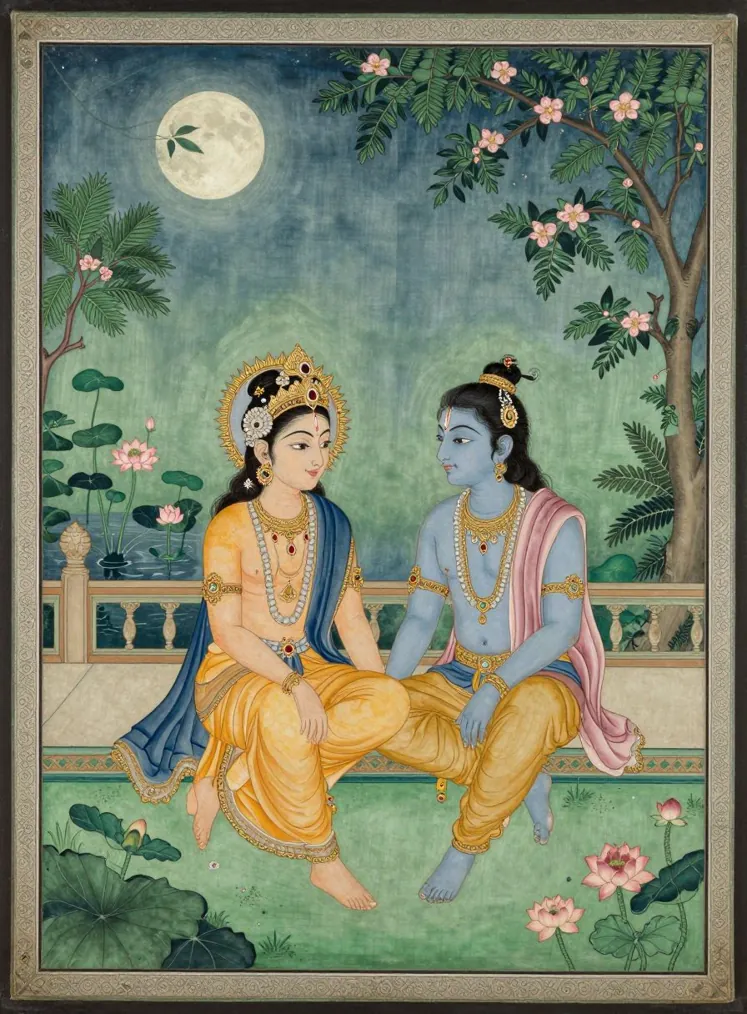
Centuries later, the Gita Govinda found its finest illustrators in the small courts of the western Himalaya. Kangra painting grew out of the Guler court in the first half of the eighteenth century, shaped by a family of painters: Pandit Seu and his sons Manaku and Nainsukh (1710–1778). It flourished under Maharaja Sansar Chand Katoch (r. 1776–1824), a devotee of Krishna, whose court became the most important centre of Pahari painting.
Kangra painters made Shringara, the rasa of love, their central theme. Their Radha and Krishna walk by the Yamuna, shelter from rain or simply look at each other in cool, luminous colour. Read more in The Painters of Kangra, and see how we describe the style in How a Style Is Built.
The eight heroines
Painters also drew on the Ashta Nayika, the eight heroines of classical poetry, each defined by a moment in love: waiting, longing, quarrelling, setting out through a storm. We tell their stories in The Eight Heroines.
How did love appear in folk art and everyday life?
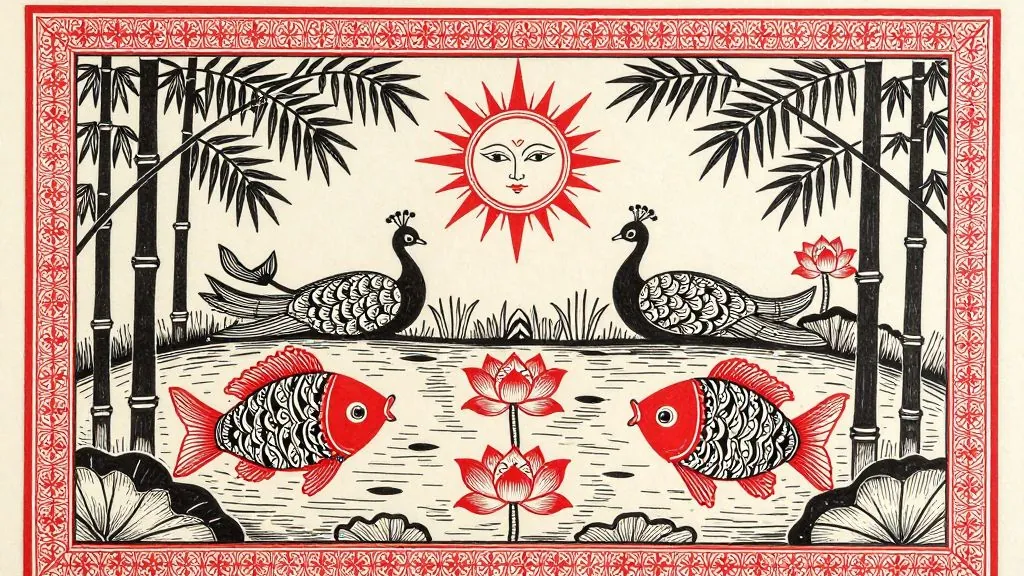
Love was not only an art of temples and courts. In the Mithila region of Bihar and Nepal, women painted the kohbar, the wall of the room where a newly married couple spent their first night. Its symbols speak of love and a shared life: lotuses, bamboo, fish, parrots, the sun and the moon, surrounded by dense pattern. These wedding walls are the ancestors of today’s Madhubani painting, which moved onto paper from the 1960s and now has Geographical Indication protection. See Madhubani: The Painted Walls of Mithila.
How should we look at this art today?
With a museum’s eye. The couples of Khajuraho, the royal pairs of Ajanta and the lovers of Kangra were made for temples, palaces and homes, as parts of a larger vision of a good life. Seen in that context, they are about harmony, devotion, beauty and the joining of two people, and sometimes of the soul and the divine.
That is the spirit in which KamZour draws on this tradition. When someone asks our Studio, Imagine, to paint the gods in love, it follows the way tradition shows them: in our published tests, a request to show Shiva kissing Parvati came back as a tender devotional embrace, as the miniatures paint them. Our Community Standards explain where we draw the lines, and our philosophy explains why we care about this heritage at all.
Frequently asked questions
Is most of the sculpture at Khajuraho erotic?
No. Khajuraho is famous for its sculptures of couples, but scenes of love make up only about a tenth of the carvings. Most of the sculpture shows gods and goddesses, dancers, musicians, warriors, animals and scenes of daily life.
When were the Khajuraho temples built?
Most of the surviving temples were completed between about 970 and 1030 CE by the Chandela dynasty. Around 25 of the roughly 85 original temples survive, and the site has been on the UNESCO World Heritage list since 1986.
Why do some Indian temples have carvings of couples?
The loving couple, or mithuna, was an auspicious motif placed on doorways, gateways and pillars to bring good fortune. It also came to symbolise the union of opposites and the harmony of worldly life (kama) with spiritual liberation (moksha).
What is the Gita Govinda?
A twelfth-century Sanskrit song-poem by Jayadeva about the love of Radha and Krishna, traditionally read as an image of the soul’s longing for the divine. It specifies the raga and tala for each song and inspired generations of painters, especially in the Kangra school.
Where can I see these artworks?
Khajuraho, Konark and Ajanta are UNESCO World Heritage Sites open to visitors. Pahari and Kangra miniatures, including paintings of the Gita Govinda, are held by museums such as the National Museum in New Delhi and the Metropolitan Museum of Art in New York, and many can be explored online on Google Arts & Culture.