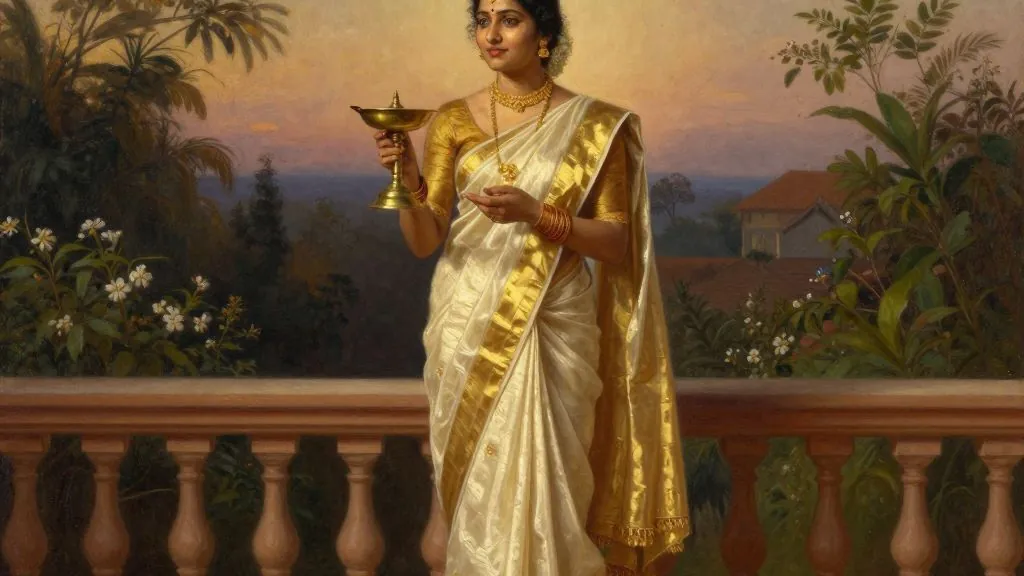
Before the press, a painting of the gods belonged to a palace or a temple. After it, a picture could hang above a lamp in almost any home.
Who was Raja Ravi Varma?
Raja Ravi Varma was a nineteenth-century Indian painter who combined European academic oil painting with Indian stories, and whose printing press made his pictures affordable to millions. He was born on 29 April 1848 at Kilimanoor palace in the kingdom of Travancore, in present-day Kerala, and died at Attingal on 2 October 1906, aged 58.
His training was a patchwork. He learned the basics of painting in Madurai, was taught watercolour by Rama Swami Naidu and, rather reluctantly on his teacher’s part, oil painting by the British portraitist Theodore Jenson. The Maharaja of Travancore, Ayilyam Thirunal, became his patron, and the Dewan of Travancore, T. Madhava Rao, was an early supporter. Later, Maharaja Sayajirao Gaekwad of Baroda commissioned a series of paintings from him for an exhibition at Baroda in 1890.
Recognition came fast. He won an award for an exhibition of his paintings at Vienna in 1873, and his paintings sent to the World’s Columbian Exposition in Chicago in 1893 earned three gold medals. In 1904 the Viceroy, Lord Curzon, conferred on him the Kaiser-i-Hind gold medal.
What made Ravi Varma’s paintings new?
Ravi Varma painted Indian subjects with the tools of European academic art: oil paint on canvas, a single consistent light, rounded modelling, deep perspective and a close study of real faces and fabrics. Before him, the gods and heroes of Indian painting usually lived in the flat, patterned worlds of the miniature, the mural or the temple icon. In his pictures they stand in rooms and gardens that look like ours.
He moved between two kinds of subject. One was scenes from the epics and the Puranas, stories that every audience in India knew. The other was portraits and scenes of contemporary life, especially women in the textiles of his time. A few of his best-known works, with their dates:
- Nair Lady Adorning Her Hair (1873).
- Shakuntala Patra-lekhan (1876), from the story of Shakuntala, which he painted more than once.
- Galaxy of Musicians (1889).
- There Comes Papa (1893) and The Gypsies of South India (1893).
- Shakuntala (1898).
The two sides of the fusion
What admirers loved and critics disliked was the same thing: the realism. A goddess painted like a real woman feels close and human. She can also feel theatrical, or less sacred. That tension is still at the heart of every argument about Ravi Varma, and we come back to it below.
Why did Ravi Varma start a printing press?
Because one painting could only hang in one place, and he wanted his pictures to reach everyone. According to the publisher’s excerpt in ThePrint, T. Madhava Rao urged him in 1884 to send some of his works to Europe to be made into oleographs, colour prints that imitate oil paintings, for distribution in India. Ravi Varma decided to make them at home instead.
In 1892, the same account says, he imported steam-driven printing machinery from Germany. His brother C. Raja Raja Varma, himself a painter who worked closely with Ravi Varma all his life, sent an agent, Abdoola Hoosein, to Germany, and he engaged the German printer Fritz Schleicher to help set up and run the press. A partner from Bombay’s mill-owning Khatau family, Goverdhandas Khatau Makanji, joined the venture.
The Ravi Varma Fine Art Lithographic Press began work in Bombay in 1894. Its first chromolithograph, The Birth of Shakuntala, came out in July 1894, followed that September by prints of the goddesses Lakshmi and Saraswati. Sources differ on where the press first stood: some place it at Ghatkopar, while the histories of the press published on Google Arts & Culture place it at Girgaum in the city.
How were the Ravi Varma prints made?
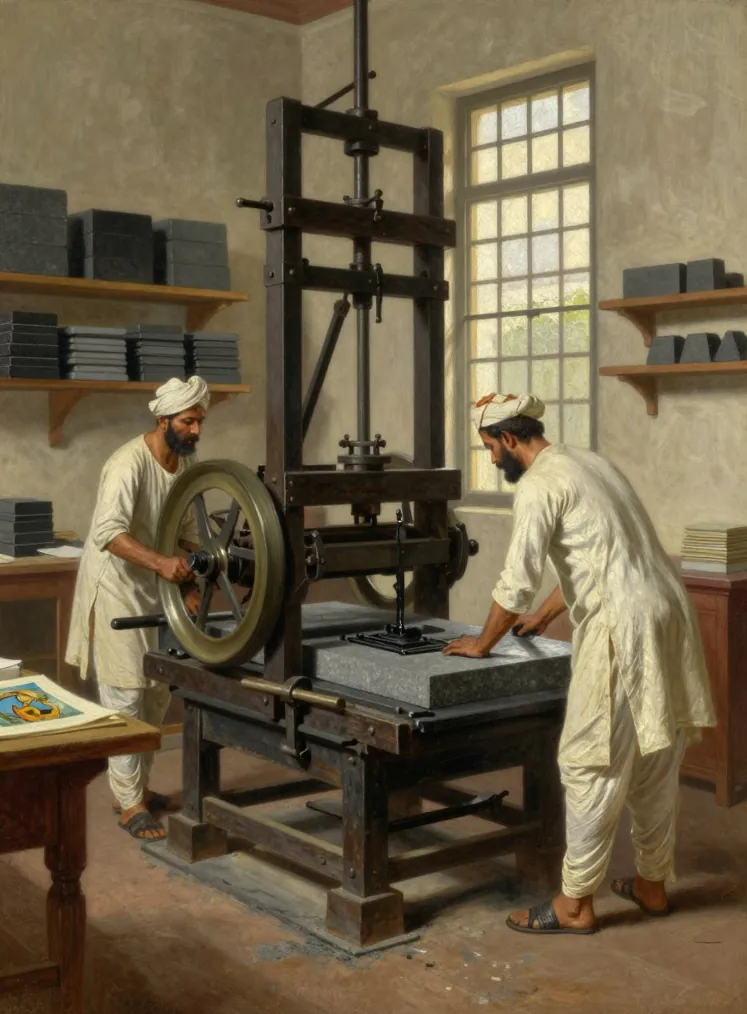
The press used chromolithography, colour printing from stone. It rests on one simple fact of chemistry: grease and water repel each other. Lithography was invented in Bavaria in 1796 by the German author and actor Alois Senefelder, and colour versions developed through the nineteenth century. The steps went roughly like this:
- Drawing on stone. An artist drew the image on a smooth slab of limestone with a greasy crayon or ink.
- Fixing. The stone was treated with a weak solution of gum arabic and acid, so the bare areas would hold water.
- Inking. The stone was kept wet and rolled with oily ink, which stuck only to the greasy drawing, and the image was pressed onto paper.
- One stone per colour. For a colour print, each colour needed its own stone, and every sheet went through the press as many times as there were colours, lined up with registration marks.
- The oleograph finish. To imitate an oil painting, a chromolithograph could be varnished or embossed with a canvas-like texture, and sometimes glued to canvas.
Skill on stone, speed in the press
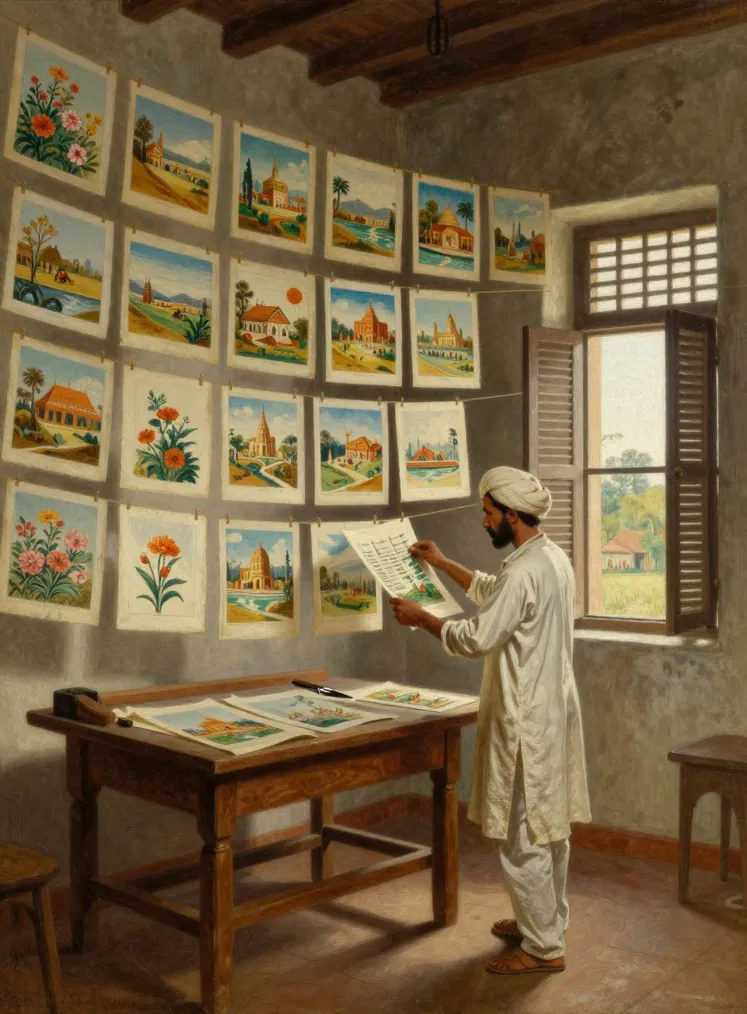
Turning a painting into a set of stones was skilled work. The Raja Ravi Varma Heritage Foundation’s account names a German lithographer, P. Gerhardt, who transferred pictures to stone, and describes Schleicher as a master of rendering human figures on stone. Once the stones were ready, the press was fast: its two machines could produce up to 800 impressions an hour. The lithographic master stones themselves were counted among the business’s capital.
What happened to the Ravi Varma Press?
Bombay was ravaged by plague in the late 1890s, and between 1898 and 1901 the press moved twice: first to Ghatkopar, then to Malavli near Lonavala. From 1901 the brothers leased the press to Schleicher and a partner, Shriram Pant, and later sold it to them along with permission to reproduce about 100 of Ravi Varma’s paintings. Schleicher was its owner by 1903.
The press kept going long after its founder. Ravi Varma’s oleographs remained popular and went on being printed in thousands after his death in 1906, and the business widened into picture postcards, advertisements, and textile and matchbox labels. Other artists worked for it too, including M. V. Dhurandhar. A fire destroyed the factory in 1972; the press shut for good in 1975, and its master stones and prints were auctioned in 2000.
How did the prints change Indian art and life?
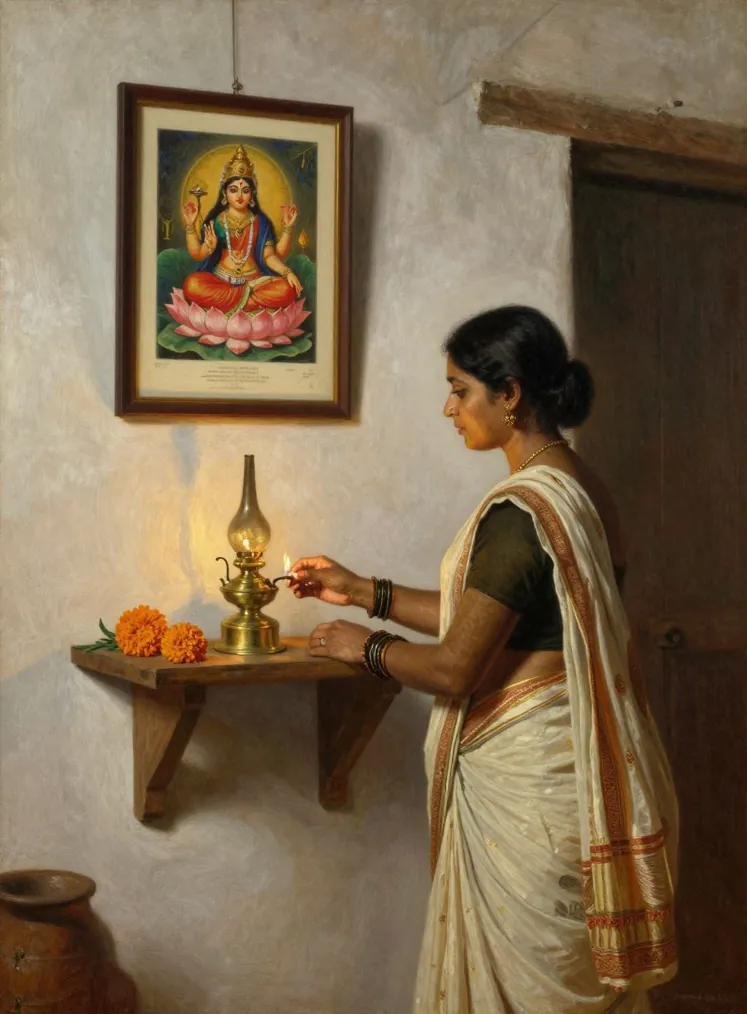
They changed who could own a picture, and what the gods looked like. The prints were cheap enough to buy and frame, so for the first time many families could keep a painted image of Lakshmi, Saraswati or Rama at home. The Ganesh Shivaswamy Foundation’s account points out that they gave people of every caste and class access to the same religious imagery, at a time when many were still barred from entering temples.
They also created a shared face for the gods. A goddess painted in Ravi Varma’s realistic manner and printed thousands of times became, for many families, simply what she looked like. Admirers and critics alike connect his manner with the calendar art and popular pictures of the twentieth century, whether they count that as a gift or a harm.
From the press to the cinema
The press touched another new art as well. In 1906 Dadasaheb Phalke, later the father of Indian cinema, set up the Phalke Engraving and Printing Works at Lonavala with R. G. Bhandarkar, and much of its early work was making photo-litho transfers for the Ravi Varma Press. Phalke went to Germany in 1909 to buy colour-printing machinery, before leaving printing for film; his Raja Harishchandra followed in 1913.
Why do critics still argue about Ravi Varma?
Because he stands at the start of modern Indian art, and people disagree about what that start should have been. The art historian Geeta Kapur wrote: “Ravi Varma is the indisputable father figure of modern Indian art.” The painter Gulam Mohammed Sheikh, in his essay “Ravi Varma in Baroda”, wrote that “the story of contemporary Indian art was never the same after Ravi Varma had entered it.”
Others were harsher. The art historian Ratan Parimoo called his work kitsch, argued that it was less spiritually authentic than folk and tribal art, and blamed it for the vulgarity he saw in popular art, from calendars to films.
Both sides have a point. Ravi Varma’s pictures can be sentimental, and his realism could crowd out the variety of older Indian painting. But he also asked a question that every Indian artist after him had to answer: how do you make art that is both modern and your own? And his press answered another question outright: art does not have to belong only to palaces.
What does Ravi Varma mean for KamZour?
His idea that art belongs in every home is one we share. Imagine exists so that anyone can make a picture in a style they love, and our style library includes academic realism, oil painting and lithographic print styles that echo his era alongside the miniature and folk traditions that came before him, such as Kangra and Madhubani.
Two rules keep that fair. We never paint the likeness of a real person, Ravi Varma included: the pictures in this article are imagined scenes of his period, not portraits. And we show sacred figures the way their traditions show them, as our Community Standards explain. You can read how our Studio handles styles and safety in our transparency notes.
Frequently asked questions
When did Raja Ravi Varma start his printing press?
The Ravi Varma Fine Art Lithographic Press began work in Bombay in 1894; its first chromolithograph, The Birth of Shakuntala, came out in July that year. It moved to Ghatkopar and then to Malavli near Lonavala between 1898 and 1901.
What is an oleograph?
An oleograph is a colour lithograph finished to look like an oil painting, by varnishing it or embossing it with a canvas-like texture, and sometimes gluing it to canvas. The Ravi Varma Press became famous for oleographs of gods, goddesses and scenes from the epics.
Why is Raja Ravi Varma important?
He was among the first to paint Indian subjects with European oil-painting techniques, and his press made affordable colour prints that brought art and a shared image of the gods into ordinary homes. The critic Geeta Kapur called him the father figure of modern Indian art.
What happened to the Ravi Varma Press?
From 1901 it was leased and then sold to the German printer Fritz Schleicher and his partner, who kept printing Ravi Varma’s pictures for decades. A fire destroyed the factory in 1972 and the press closed in 1975.
Did Dadasaheb Phalke work with the Ravi Varma Press?
Yes, indirectly. His Phalke Engraving and Printing Works, founded at Lonavala in 1906, did much of its early work making photo-litho transfers for the Ravi Varma Press, before Phalke turned to cinema.
References and further reading
- Wikipedia: Raja Ravi Varma
- Google Arts & Culture: Wanderers Between Worlds, the story of the Ravi Varma Press
- Google Arts & Culture: The Ravi Varma Press, the 125-year commemorative
- ThePrint: How Raja Ravi Varma Press revolutionised printing in modern India
- Live History India: Ravi Varma, Art for All Times
- Wikipedia: Chromolithography
- Wikipedia: Oleograph
- Wikipedia: Dadasaheb Phalke